
ceiu’ — ceiu’…
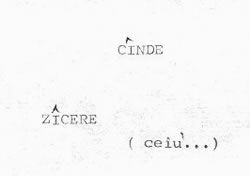
The cosmic book, handmade and placed online — twenty-three zîceri of storms, the sky, a gaze returned. Each verse is shown as the scanned typewriter page, a transcription, and a reader’s note. Notes are interpretive prose, not translations; confidence varies and is lower on the denser opening verses, as flagged within individual notes. Recordings are forthcoming.
The book of the sky.
The last book was made by hand and put online, seven years after the second, by which time the poet was an ocean away and had become a physician. Everything that was crowded and human in măiu has thinned here into weather. The neighbors are gone. What remains is the speaker, the elements, and a sky that has begun, unmistakably, to look back.
ceiu’ moves like a small storm-cycle. A storm gathers around a tree, and the speaker feels it strike his own lip — by the end of the verse he and the tree are the same thing the cloud is coming for. A knot in the wood is addressed with patient, almost prayerful tenderness, asked to soften, to open. The sky is imagined as a bridegroom who wants to rain and can only manage dryness. A figure stands broken beside a pine, cursing not the world but his own straightness, his having stood.
And then comes the verse that is the clearest in all three books — the one where the speaker confesses he does not look up, because the sky might catch him; and that if he did look, the sky would look back, and they would watch each other, one across from another, until they spun together. The fear of being seen and the longing to be seen turn out to be the same thing. It is the emotional center of the whole work.
The book — and the whole three-book arc — closes not in grandeur but in plainness. After the doctrine and the village and the weather, the last words are the ones a grandmother uses, the ones a pediatrician uses with a frightened parent: numa’ bine-i, iacă — “it’s only good, look.” Everything has worn down, at last, to reassurance.
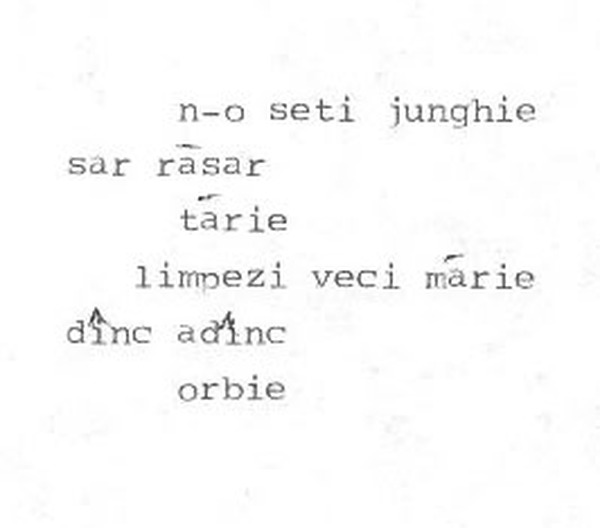
    n-o seti junghie
sar răsar
  tărie
limpezi veci marie
dinc adînc
  orbie
The book opens almost as a hymn-fragment. The line endings repeat in -ie — junghie / tărie / marie / orbie (stab / strength / Marie / blindness) — doing chant-work. Imagery cluster: rise , thirst , strength , limpid eternities , down within , blindness . The verse reads as opening invocation, the kind of fragment a folk-prayer might begin with: not a sentence so much as a gathering of words at the threshold. (Low-medium confidence; I can name fragments but not assemble them.)
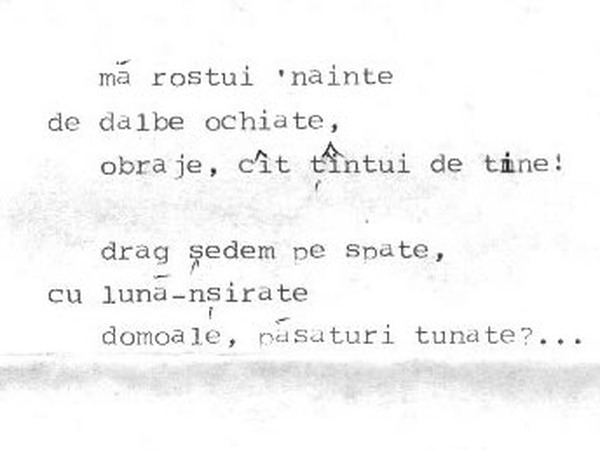
  mă rostui 'nainte
de dalbe ochiate,
obraje, cît țîntui de tine!

drag ședem pe spate,
cu lună-nsirate
domoale, păsaturi tunate?…
I prepare myself before fair gazings — cheeks, as much as I aim at you! Second stanza: dearly we lie on our backs, with moon-strung gentleness, thundered footsteps? A clear address to a “you”, a preparation, a tentative question about how they will lie together under the moon. After the chant-opening of #1, the book’s second verse is intimate and small: a getting-ready, a tender question. The voice is quietly courting.
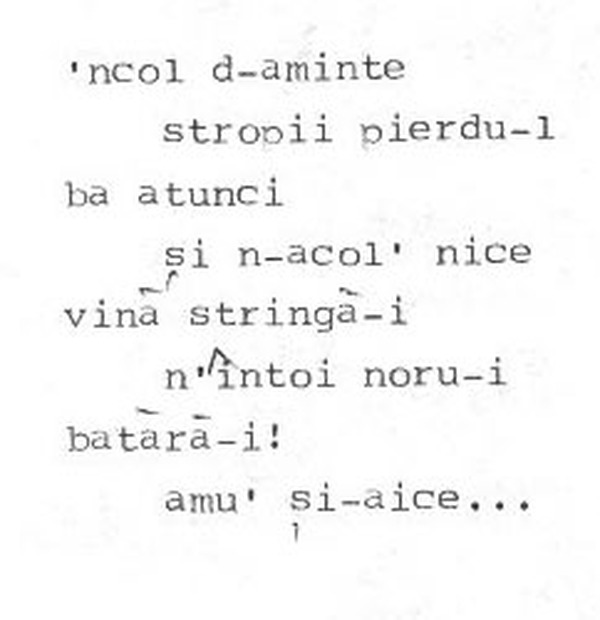
'ncol d-aminte
  stropii pierdu-l
ba atunci
  si n-acol' nice
vina stringa-i
  n'întoi noru-i
batără-i!
  amu' si-aice…
The drops lost, the vein gathered, the cloud turned around, struck off — now and here . The verse is a sequence of compressed gestures ( 'ncol , amu' și-aice ) marking thereness and hereness as if walking the speaker through a passage of locations. Drops, vein, cloud, here. I can see the imagery clusters — weather, drops, the body’s vein — but the syntactic glue is hard to make out. (Low confidence; the verse is dense with dialect coinages I can’t reliably assemble.)
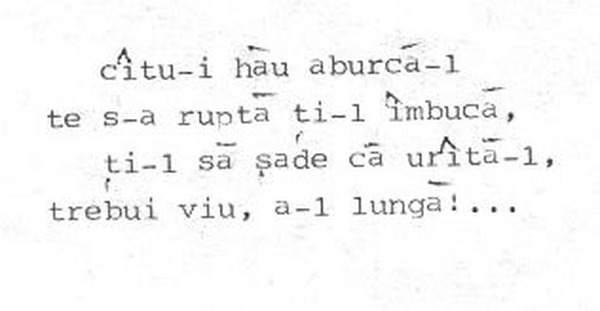
  cîtu-i hău aburca-l
te s-a rupta ti-l îmbuca,
  ti-l să șade că urîta-l,
trebui viu, a-l lunga!…
A short imperative verse. However great the void, lift him up; if he tears at you, you’ll devour him; if he sits because he is ugly, he must live — lengthen him! Urgent instructions about a third figure, given in rapid imperatives. After the courtship of #2 and the situating of #3, this verse reads as charge given to someone — or to the self — about how to handle a difficult man. Trebui viu, a-l lunga — he must live, lengthen him — lands as the verse’s held line.
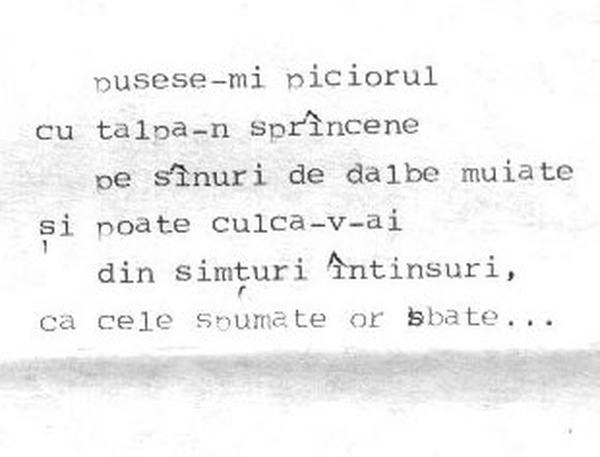
  pusese-mi piciorul
cu talpa-n sprîncene
pe sînuri de dalbe muiate
și poate culca-v-ai
  din simțuri întinsuri,
ca cele spumate or sbate…
An erotic verse, the clearest physical body in the book so far. I had set my foot, sole on eyebrow, on breasts of soft fair ones — and perhaps you’d lie down from extended senses, as the foamy ones might beat. The image of a foot resting on someone’s eyebrow, then on softer ground; the speaker hovers between aggression and intimacy. The verse ends in spumate or sbate — foamy ones might beat — bringing in the sea or the wave or simply foam-as-figure. Light, sensual, almost shameless.
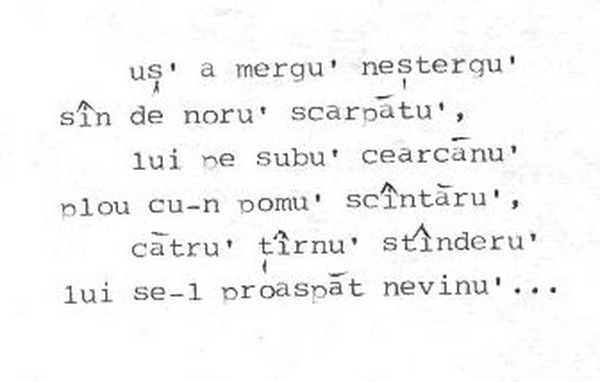
  uș' a mergu' nestergu'
sîn de noru' scarpatu',
lui pe subu' cearcanu'
plou cu-n pomu' scîntaru',
  catru' tîrnu' stinderu'
lui se-l proaspăt nevinu'!…
A door of walking, of un-wiping. A breast of cloud, scratched. Lui pe subu' cearcanu' — to him beneath the dark eye-circle. Then plou cu-n pomu' scîntaru' — it rains with a sparking tree; catru' tîrnu' stinderu' — toward the spreading stand. The verse closes lui se-l proaspăt nevinu' — let him be fresh, un-guilty. Image cluster: door, cloud, eye-circle, sparking tree, fresh-and-innocent. (Low confidence; the verse is dense with coinages, my reading holds the imagery more than the literal events.)
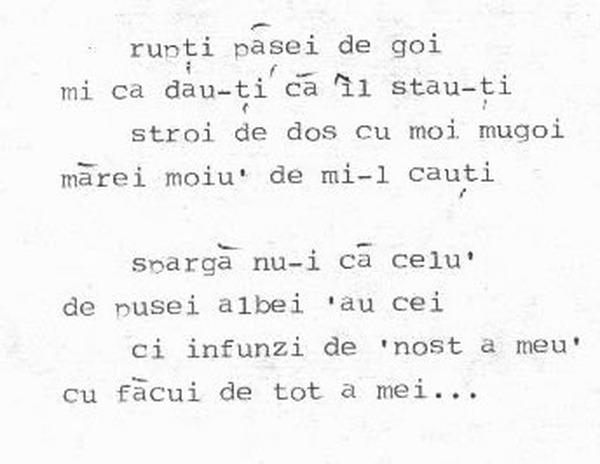
  rupti pasei de goi
mi ca dau-ți că îl stau-ți
  stroi de dos cu moi mugoi
mărei moiu' de mi-l cauți

  spargă nu-i că celu'
de pusei albei 'au cei
  ci infunzi de 'nost a meu'
cu făcui de tot a mei…
Broken to walk empty. Branches of moss, soft tendrils, the moiu’ (mossy one) being looked for. The cellu’ does not break ; from the white ones I will lay down, from these ones I will sink into my own mine, with the making of all that’s mine. The verse turns on possessive forms — 'nost a meu' , de tot a mei — mine, of mine, all-of-mine. A verse of claiming or self-claiming, but the literal action is hard to follow. (Low confidence; the description holds the register more than the literal events.)
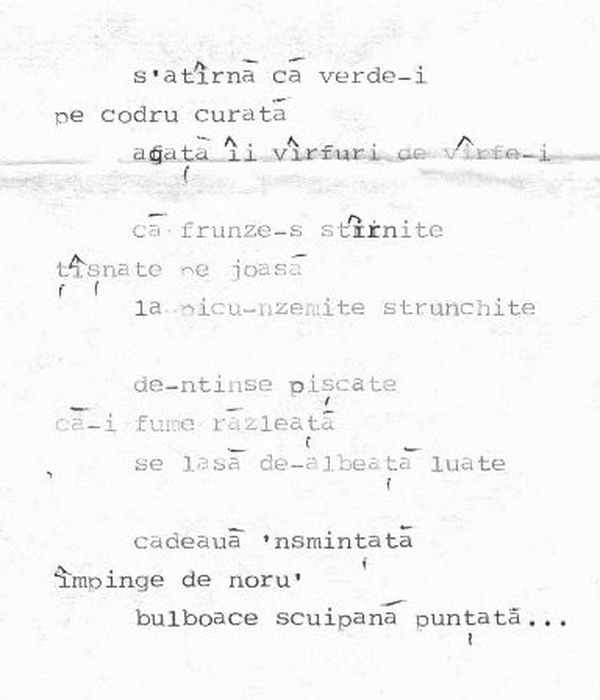
  s'atîrnă că verde-i
pe codru curată
agată îi vîrfuri de vîrfe-i

  că frunze-s stîrnite
țîsnate pe joasa
  la picu-nzemite strunchite

  de-ntinse piscate
că-i fume razleată
  se lasă de-albeată luate

  cădeauă 'nsmintată
împinge de noru'
  bulboace scuipană puntată…
A long verse of trees and falling things. It hangs because it’s green — on the clean forest — catching in the tips of its tips. Stanzas accumulate: leaves stirred up and gushed down; piscate (cuts) extended; foamy fume let down by whiteness; cădeauă 'nsmintată — a falling astray, pushed by the cloud, bubble-pools spitting dotted. The verse is the book’s most painterly so far — image after image of falling and catching, no single arc but a sustained looking. (Medium-low confidence; I can name the image clusters but not always their order.)
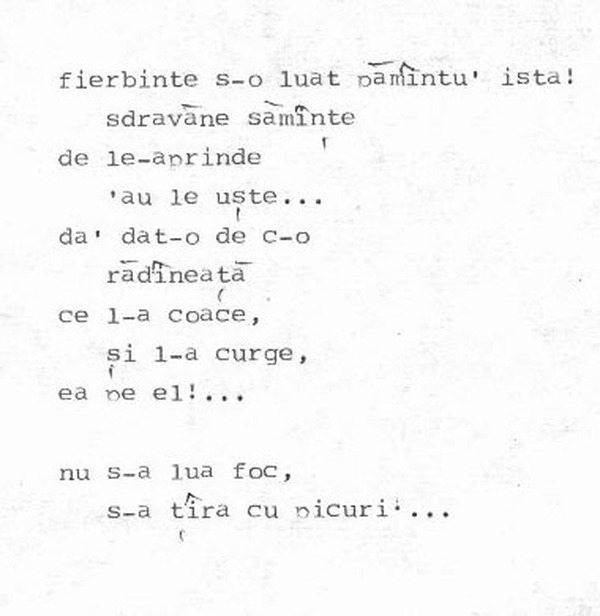
fierbinte s-o luat pămîntu' ista!
  sdravane saminte
de le-aprinde
  'au le uste…
da' dat-o de c-o
  rădineață
ce l-a coace,
  si l-a curge,
ea pe el!…

nu s-a lua foc,
  s-a tîra cu picuri'…
This earth has gone hot! Sturdy seeds — to be set on fire or dried out. But the earth gave them a small rootlet, which will cook them and pour them — ea pe el , she over him. Closes: it will not catch fire, it will crawl with droplets. A verse about heat, drought, seed, root, gender. The ea pe el (she over him) is the load-bearing image — the rootlet that doesn’t burn the seed but drips over it. A verse about persistence at the cost of catching.
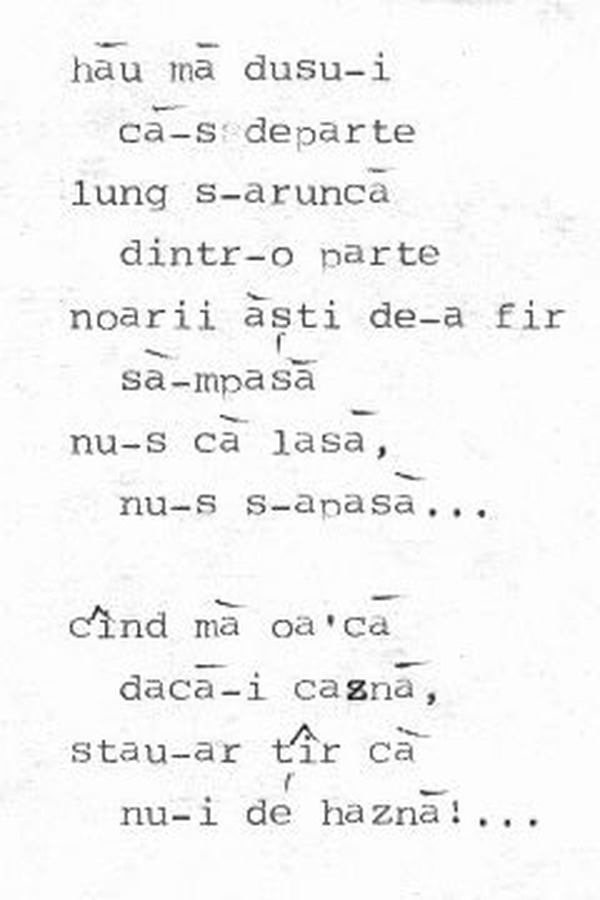
hău mă dusu-i
  că-s departe
lung s-arunca
dintr-o parte
noarii ăsti de-a fir
să-mpasă
nu-s că lasa,
nu-s s-apasa…

cînd mă oa'că
daca-i cazna,
stau-ar tîr că
  nu-i de hazna!…
The void carried me — for I am far — thrown long from one side. These clouds threaded by a hair, not to be let go, not to press down. Second stanza: when she eyes me — if it is the labor — would she stand for it; it’s of no use! A verse of distance and the labor of being looked at. After the courtship of #2 and the foam of #5, the speaker here is far away, threading toward something, doubting whether the looking is worth it.
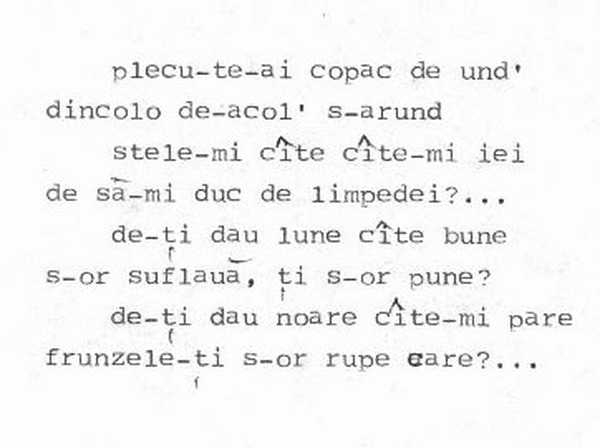
  plecu-te-ai copac de und'
dincolo de-acol' s-arund
stele-mi cîte cîte-mi iei
de să-mi duc de limpedei?…
  de-ți dau lune cîte bune
s-or suflăua, ti s-or pune?
  de-ți dau noare cîte-mi pare
frunzele-ți s-or rupe care?…
A bargaining with a tree. Would you go, tree, from where — beyond there, throw yourself? How many stars at a time will you take from me, so I can carry off some clarities? If I give you good moons, will they breathe on you, will they settle? If I give you clouds however many seem right — which leaves of yours would break? The verse is structured as a series of offers and questions to a tree: trades of stars, moons, clouds for the tree’s departure, breathing, settling, breaking. The closest the first half of the book comes to the patient address of #15. The tree is being negotiated with.
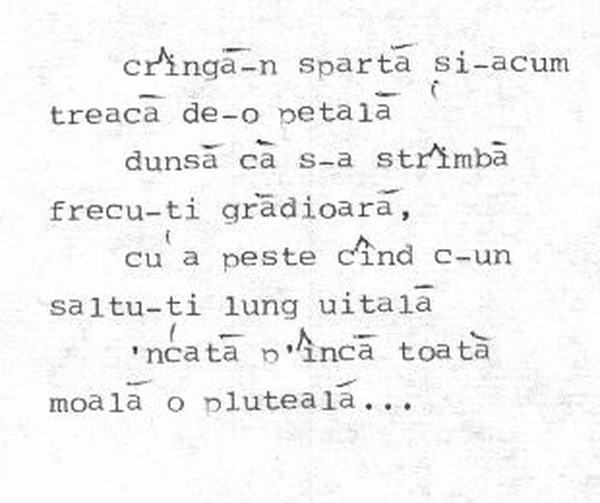
  crînga-n sparta si-acum
treaca de-o petală
  dunsă că s-a strîmba
frecu-ți grădioara,
  cu a peste cînd c-un
saltu-ți lung uitală
  'ncata p'încă toată
moală o pluteală…
A broken branch, and now — let a petal pass. Perhaps it will twist, rub at the little garden. With its over-when-with a long leap forgotten. 'ncata p'încă toată / moală o pluteală — sated still everywhere, softly a floating. A verse of small motions passing through and the soft settling that follows. After #11’s bargaining, this is what happens when the bargain doesn’t need to be made — the petal passes anyway, the garden gets brushed, the leap is forgotten, the floating is soft.
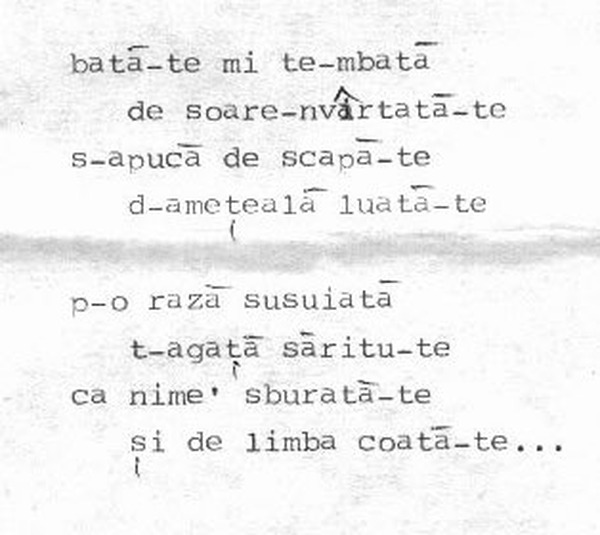
bată-te mi te-mbată
  de soare-nvîrtată-te
s-apucă de scapă-te
  d-ameteală luată-te

p-o rază susuiată
  t-agata sărîtu-te
ca nime' sburată-te
  si de limba coată-te…
Every line ends in -te — you . Beat-you, drunken-you, from sun-turned-you, grabbed-you, freed-you, dizziness-taken-you, hissed-ray-hung-you, risen-you, nobody-flown-you, of-tongue-tasted-you. The verse is one long second-person address woven into every verb. The grammatical insistence on you is the verse’s whole engine. Beating, turning, freeing, hanging, rising, flying, tasting — all done to you . After the bargaining with the tree (#11) and the floating petal (#12), this verse is the speaker doing things to the addressed beloved — and the doing is also a being-done-to, since the -te endings could read as middle voice. The closest the first half of the book comes to the mutual gaze of #22. Contact Instagram © 2026 C Fodoreanu · San Diego · New York
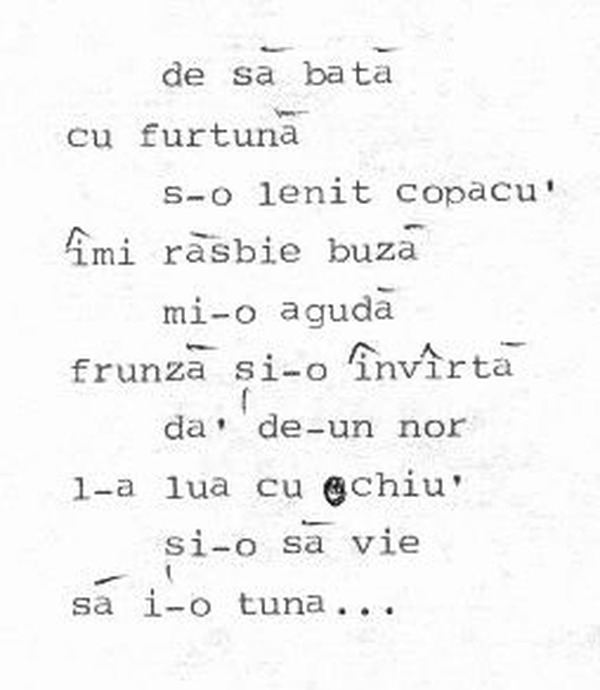
    de să bata
cu furtună
  s-o lenit copacu'
îmi răsbie buza
mi-o aguda
frunza si-o învîrta
  da' de-un nor
l-a lua cu ochiu'
  si-o să vie
să i-o tună…
A storm gathers around a tree. The tree wearies. The speaker’s lip throbs as if struck. A leaf turns. A cloud sights the tree and gathers to thunder down on it. Across the verse the “him” fuses tree and speaker — both are what the storm comes for. The poem moves from external weather to inward sympathy: by the time the cloud is “coming” to thunder, the threat reads as personal.
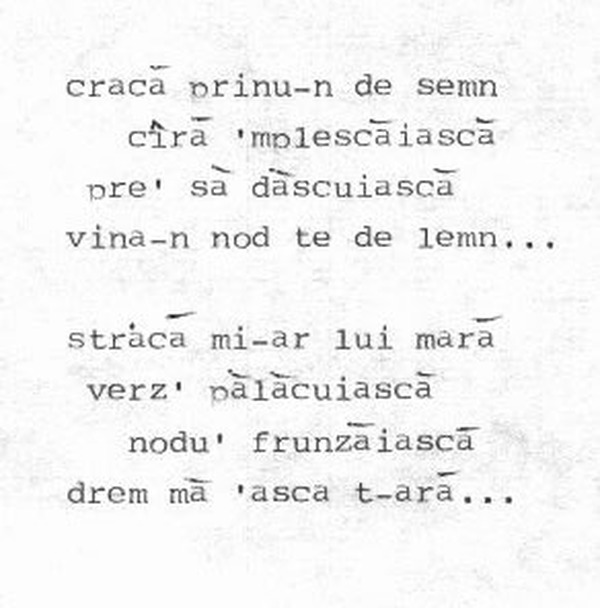
cracă prinu-n de semn
  cîra 'molescaiasca
pre' să dăscuiască
vina-n nod te de lemn…

stracă mi-ar lui mara
verz' palacuiasca
  nodu' frunzaiasca
drem mă 'asca t-ara…
A branch held as a sign. A knot in the wood. Across the verse, subjunctive imperatives — may it soften, may it unlock, may the knot leaf — address the tree-knot as if it could open. The poem speaks to wood as something that might still respond. The second stanza dims into greens and paleness and ends with what reads as a release into “again,” though the closing line resists me. The poem’s shape is one of patient address — speaking gently to a knotted thing in hope of its giving way.
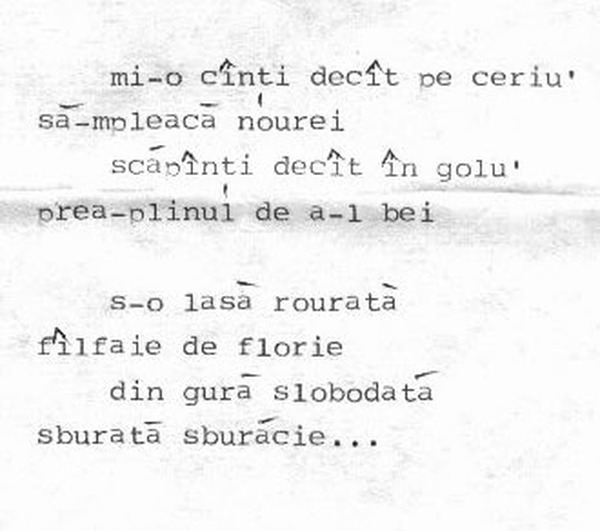
  mi-o cînti decît pe ceriu'
să-mpleaca nourei
  scapînti decît în golu'
prea-plinul de a-l bei

  s-o lasă rourată
fîlfaie de florie
  din gură slobodată
sburată sburăcie…
Something sings to the speaker on the sky — let the little clouds lean toward it. Sparks fall in the empty, the over-fullness ready to drink. The second stanza turns to release: let her leave dewed, a flutter of bloom, the mouth freed, flight given to flight. Across the verse, the voice is invocational — let it sing, let it lean, let it leave — addressing the sky and the bloom and the freed mouth as if they share one giving-over. The poem closes in motion: sburată sburăcie , flown into flight.
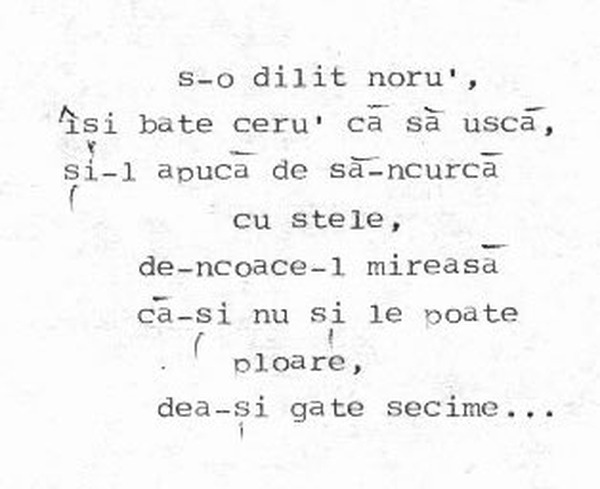
  s-o dilit noru',
îsi bate ceru' că să ușcă,
si-l apucă de să-ncurcă
    cu stele,
de-ncoace-l mireasă
că-si nu si le poate
    ploare,
  dea-si gate secime…
The cloud has thinned. The sky beats itself because it dries. The sky catches at the cloud, tangles it with stars, brings the cloud near like a bride — but cannot rain its stars, gives itself only as dryness. The image at the centre is the sky as a bridegroom unable to give itself over; the marriage is to dust rather than to water. A short, dense verse turning on the failed offering: the sky wants to pour and finds itself bringing only stars and dryness instead.
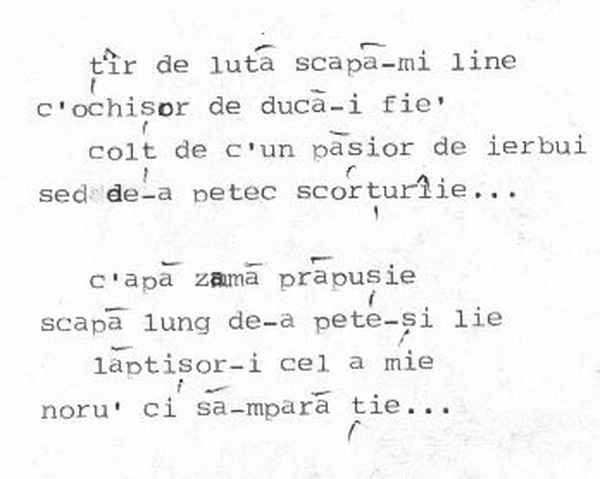
  țîr de luță scapă-mi line
c-ochișor de duca-i fie
colț de c-un păsior de ierbui
sed de-a petec scorturlie…

c'apa zamă prăpusie
scapă lung de-a pete-si lie
  lăptișor-i cel a mie
noru' ci să-mpara tie…
A thread of moonlight escapes gently. A small eye for the going. A corner with a step of grasses; something sits as a crust or patch. The second stanza turns to water and depletion: the broth thinned, escape stretched into patches, the small milk that is mine, a cloud that divides itself for you. Across the verse, the imagery clusters around small things almost gone — thread, eye, step, patch, broth, milk — gifts at the threshold of disappearance. The poem reads as a quiet inventory of what little remains, and what of that little is being offered. (The closing lines resist a clean reading; the description holds the register more than the literal events.)
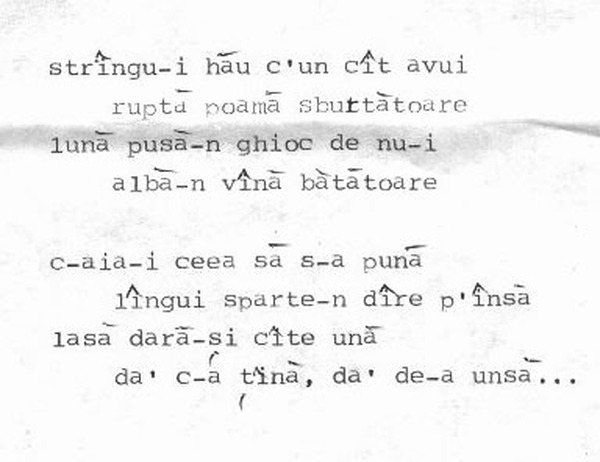
stringu-i hău c-un cît avui
  rupta poamă sbuftătoare
lună pusă-n ghioc de nu-i
  alba-n vînă bătătoare

c-aia-i ceea să s-apună
  lîngui sparte-n dîre p'însă
lasa dară-si cîte una
  da' c-a țînă, da' de-a unsă…
A gathering in. The speaker gathers what little they had — a void, with as much as they had — alongside a broken fruit gushing, a moon placed in a shell where there is none, a white-in-the-vein striking. The second stanza turns to leave-taking: let them be set down, broken loose in traces, one by one — but as the thing holds, as it is anointed. The verse is an inventory of brokenness presided over with care: each broken thing named, each given its anointing. (A medium-confidence reading; some images may be wide of the mark.)
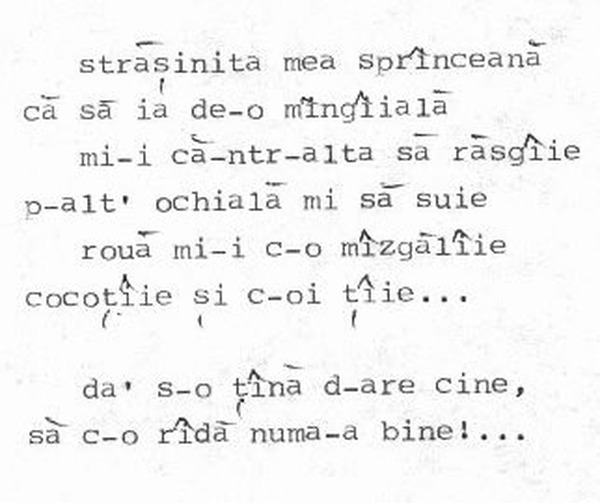
strasnita mea sprînceană
că să ia de-o mîngîială
  mi-i că-ntr-alta sa răsgîie
p-alt' ochială mi să suie
roua mi-i c-o măzgăliie
cocotăie si c-oi tîie…

da' s-o țîna d-are cine,
să c-o rîda numa-a bine!…
A fierce brow softens to be caressed. The speaker is glanced at, climbed on, scribbled on by dew, perched on and trimmed. The verse opens in self-description — a sprînceană (eyebrow / brow) that is at once strasnită (fearsome) and ready for a touch — and turns in the second stanza outward: but let her hold, if anyone will; let her laugh only well . A small inward verse about being looked at, marked, and given over to whatever good gaze remains.
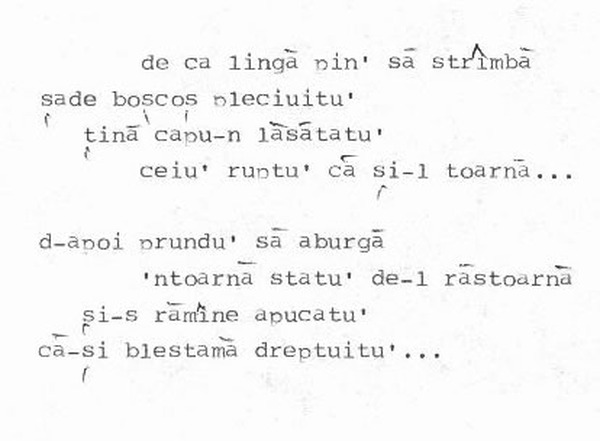
    de ca lîngă pin' să strîmbă
sade boscos pleciuitu'
  țîna capu-n lăsătatu'
  ceiu' ruptu' că si-l toarnă…

d-apoi prundu' să aburgă
    'ntoarnă statu' de-l răstoarnă
si-s rămîne apucatu'
că-si blestămă dreptuitu'…
A figure bent next to a pine. The stooped one, head let down, the broken ceiu’ pouring itself. Then the gravel rises, turns the standing thing, overturns it — and the figure remains caught, cursing his own uprightness. After the patient, accepting tone of the verses around it, this one turns hard: the figure is undone in place, and the curse falls not on the world but on his own having-stood. The standing was what made him brittle.
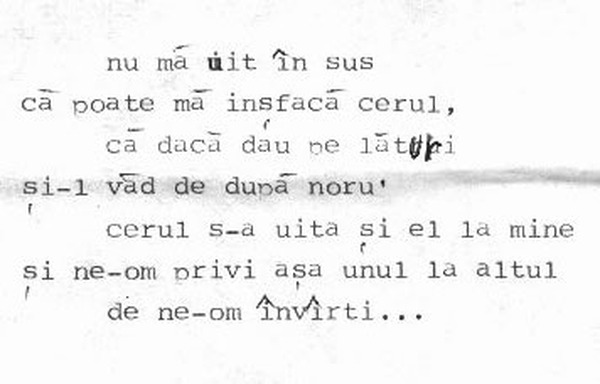
nu mă uit în sus
că poate mă insfaca cerul,
  că daca dau pe lături
si-l văd de după noru'
  cerul s-a uita si el la mine
si ne-om privi așa unul la altul
  de ne-om învîrti…
The clearest and most intimate verse in the book. I don’t look up, because maybe the sky will catch me; because if I look sideways and see it from behind the cloud, the sky will look at me too — and we’ll watch each other like this, one across from another, until we spin together. The whole arc of giving-over and being given to closes here as mutual gaze. The speaker fears being caught and at the same time names the catching as a spinning-together — the fear is also the hope.
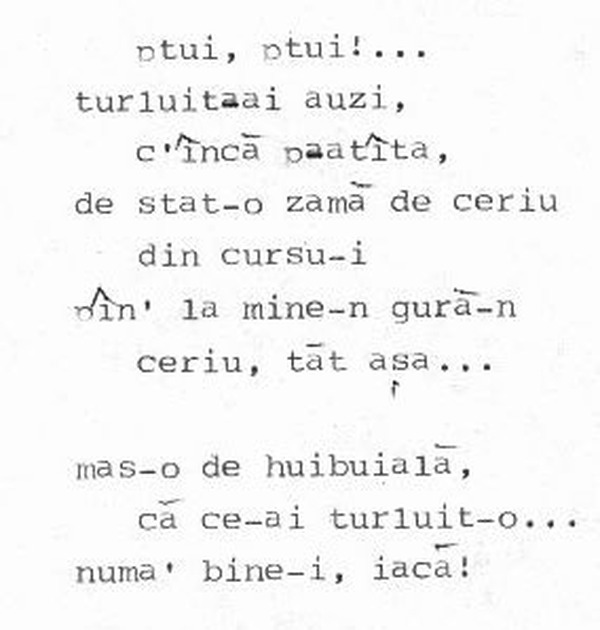
  ptui, ptui!…
turluitaai auzi,
  c'încă paatita,
de stat-o zamă de ceriu
din cursu-i
  din' la mine-n gură-n
ceriu, tăt așa…

mas-o de huibuiala,
  că ce-ai turluit-o…
numa' bine-i, iacă!
A spit of dismissal opens the book’s last verse. You’ll hear the chattering, because you’ve still endured it — a broth of sky has stayed from its current, from me to mouth, to sky, just so. Second stanza: Leave the babbling, what you’ve chattered — it’s only good, look! The book closes with a colloquial, almost familial gesture — a dismissive spit, a complaint about chatter, then reassurance. After all the weather and gathering and overturning, the final note is plain speech: numa’ bine-i, iacă — it’s only good, look. Contact Instagram © 2026 C Fodoreanu · San Diego · New York