
întru — întru acela ce mi-e totunu
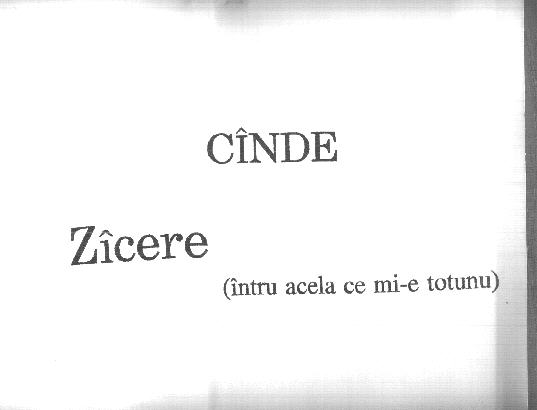
Thirty-six zîceri. Each verse is shown as the scanned typewriter page, a transcription, a reader’s note, and — where it exists — the poet’s own reading. Notes are interpretive prose, not translations; confidence varies and is flagged within individual notes. Audio currently exists for the first verse only.
The book of the threshold.
The first of the three books opens in the hardest place — a language reaching for something it cannot quite name. Its title is also the beginning of its subtitle: întru acela ce mi-e totunu, “in the one for whom it is all the same.” The phrase is doctrinal without being devotional. It points at a single addressee — call it God, or the dead, or the self, or the whole — to whom the speaker keeps turning, and toward whom the whole book is walking.
întru is the most theological of the three, and the most formally severe. A verse stacks a word on itself until it contains its own smaller version — the under of the under, the gathering of the gathering — and you feel the book testing whether language can hold the infinite by folding it. Another verse becomes a candle, becomes rain, falls in order to quench an immortality that should not, by every rule, be quenched. These are not the gestures of a young poet showing off. They are the gestures of someone who has inherited a sacred grammar and is finding out, in real time, what it can still do.
And then, without warning, the book lies down in the grass. A body dozes in the sun, half-attending to a pebble, suckled by stars. A household dog is asked to carry off the speaker’s sayings. The doctrine never leaves, but it learns to live in a body — which is, in the end, this whole practice’s subject.
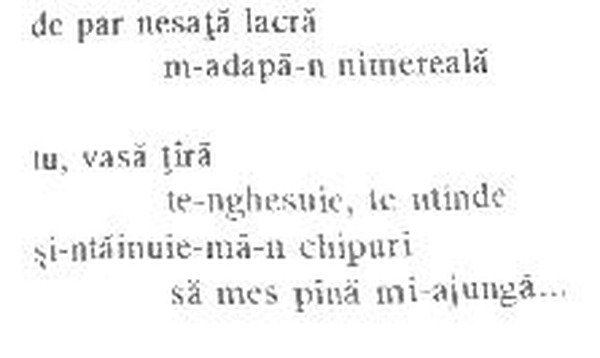
The book closes by promising to keep going: să mes pînă mi-ajungă — “that I might walk until I get there.” It is the truest possible ending for a first book. Nothing has arrived yet. Everything is still ahead. The poet is simply, faithfully, on the way.
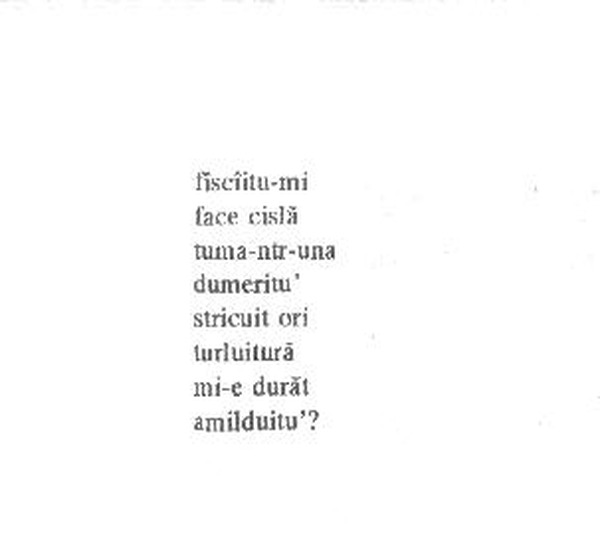
fiscîitu-mi
face cislă
tuma-ntr-una
dumeritu'
stricuit ori
turluitură
mi-e dărăt
amilduitu'?
The book opens in opacity. Fiscîitu-mi face cislă — what whispers in me makes a tithe? — tuma-ntr-una , only into one. The whole verse is a sequence of compressed, dialect-coined gestures asking what the speaker has been left with: a sound, a tithe, a sieved-out thing, a small charm. The final word, amilduitu'? , is itself a question. The book begins by asking what it is. A threshold-poem in the strictest sense — the poet hasn’t named what he is doing yet; he is still feeling for it. (Low confidence; the verse is dense with coinages and the literal action is opaque.)
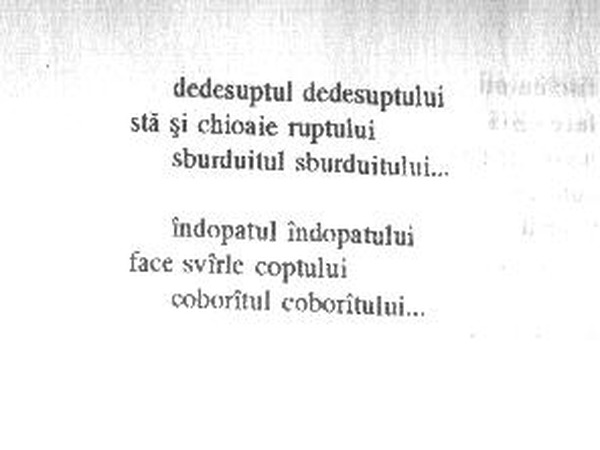
  dedesuptul dedesuptului
stă și chioaie ruptului
  sburdaie sburduitului…

  îndopatul îndopatului
face svîrle coptului
  coborîtul coborîtului…
Dedesuptul dedesuptului — the under of the under. The verse stacks each noun on itself: under of under, gathering of gathering, scatter of scatter, indulgence of indulgence, cooking of cooking, descending of descending. A formal verse of doubled possessives in two parallel stanzas. The shape itself does most of the work: each thing is shown to contain a smaller version of itself, all the way down. Whatever is happening is happening recursively.
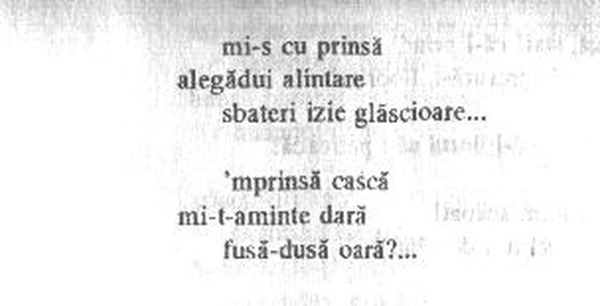
  mi-s cu prinsă
alegădui alintare
  sbateri izie glăscioare…

  'mprinsă cască
mi-t-aminte dară
  fusă-dusă oară?…
A small intimate verse of recovered breath. I’m caught up — you fed me a soothing — small striking voices… Second stanza: caught open-mouthed — you’d remember, then — was it a single moment that passed? A verse about being interrupted by something or someone and then turned, briefly, back to that moment. The question that closes it ( fusă-dusă oară? ) is the verse’s held line: was that a single hour?
că, stai! că-l prind!
  împresură-l, l-oprim!

petreacă-l dorul să-l petreacă!

că l-am scăpat!
  cel nor de vînt…
A short urgent imperative verse. Wait! I’ll catch it! Surround it, we’ll stop it! — let the longing carry it where it carries it! — oh, I’ve let it slip! — that cloud of wind… A wind-chase that fails. The voice tightens with each line and breaks open at the end. A pure exclamatory verse, all action, no abstraction. The thing being chased is uncatchable by design.
  mă luai, luai
miriui m-aruncai
  pîntecu-mi umflai
beucă porneai
  hududoi-ncoace

aducu-ți ulcică
  bolbucei de apă
blorcotește-ți pică
  curenduș te-ncapă
dară, gîlgăuțe…
A verse of water-receiving. I took up, I took up — I cast myself little — I swelled my belly — I started in a torrent — downhill this way… Second stanza: I bring you a little jug — the water’s bubblings — let them well up and drip on you — quickly let it catch you — you sweet thing, you bubbling one. A child-or-river voice offering water as a gift. The voice is delighted, almost giggling. The closing diminutive gîlgăuțe (you little gurgler) is the verse’s tenderest moment.
  înfioară bunăoară
semnu-albastru din fîntînă
  drămuie-l sub subsuoară
fură-i dangul rotocoală

  rotocel să-ți rotocească
jibul hîtru astătutul
  facă-se să-ți despuiască
chinuială ș-abătutul
A folk-charm verse, addressed to something or someone. Stir up the so-and-so — blue sign from the well — measure it under the armpit — steal its ring of throbbing. Second stanza: let a small ring spin for you — the cunning oddity that endures — let it shake you free — the suffering and the cast-off. The first stanza measures and steals; the second releases. Reads as a healing incantation in two halves — identify the thing, then drive it off. (Medium-low confidence; the charm-shape is clearer than each line.)
ram, ramure de fele
svînte-le poamele și-mbucă-le viernele
devreme-i de tralalele
risipă-i de rîndunele…

amu', astîmpără-le jițele
și merc-le pe perel
Branch, branchings of slips — an opening address to a fruit-tree. Drown the fruits and seize the little buds — too soon for tralala-songs — too late for swallows… Second stanza: now — calm down their fevers — and let me throw them all on the wall. A spring verse about a fruit tree pulled out of season, the speaker exasperated with its early bloom or impatient with its silence. The closing line — and let me throw them all on the wall — reads like a child’s gesture, plucking unripe fruit to flick against a wall. (Medium confidence.)
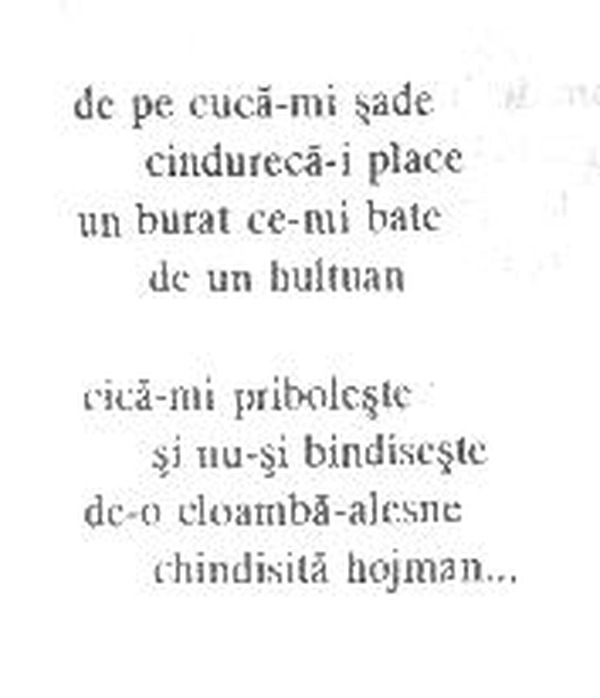
de pe cucă-mi șade
  cindurecă-i place
un burat ce-ni bate
  de un hultuan

cică-mi pribolește
  și nu-și bindisește
de-o cloambă-alesne
  chindisită hojman…
A figure-on-a-hill verse. On the hilltop he sits — the little fool’s comfort pleases him — a buzz drives at me — from a swarm. Second stanza: he says he’s wandering and pays no mind to anyone — from a single chosen branch — embroidered all the time. A small character sketch: someone the speaker can see sitting up on a hill, content in foolishness, distantly accompanied by something buzzing. A village vignette — one of the rare verses in întru that pictures another person. (Medium confidence; the figure is clearer than the precise verbs.)
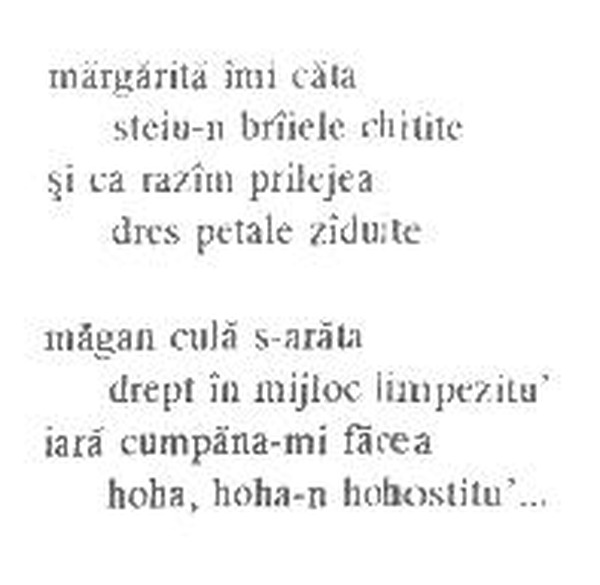
mărgărita îmi câta
  steiu-n brâiele chitite
și ca razim prilejea
  dres petale ziduite

măgan culă s-arăta
  drept în mijloc limpezitu'
iară cumpăna-mi făcea
  hoha, hoha-n hohostitu'…
A verse of pearl-and-star imagery. The little pearl was looking for me — a star in tied-up tassels — and like a prop she was making it happen — arranged with petals built up. Second stanza: a great mound revealed itself — right in the middle, in clarity — and yet my reckoning was made — ho-ha, ho-ha in laughter… A verse with a clearly female figure ( mărgărita ) and a found revelation in the middle. The closing onomatopoeia hoha, hoha-n hohostitu' is the verse’s peculiar laugh-cadence. (Medium confidence.)
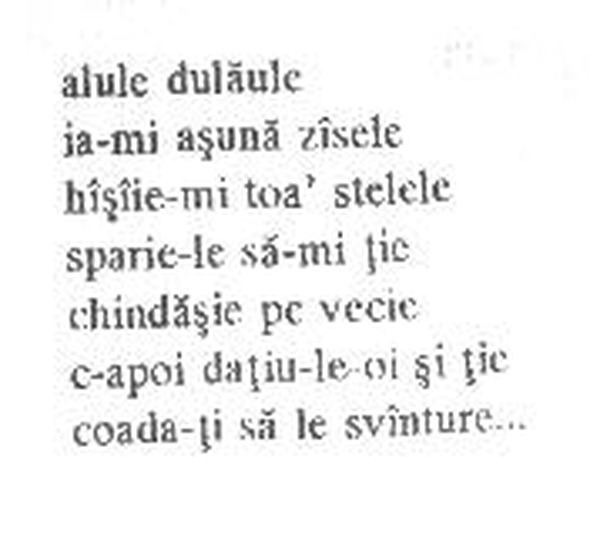
alule dulăule
ia-mi așună zicele
hîșlie-mi toa' stelele
sparie-le să-mi țîe
chindășie pe vecie
c-apoi dațiu-le-oi și țîe
coada-ți să le svînture…
A verse spoken to a dog. Little Alule, big dog — carry away my sayings for me — chase off all my stars for me — scare them so they hold for me — their stitching for ever — for I’ll give them over to you — let your tail sweep them away… A folk-poem to a household dog, asking it to carry off the speaker’s sayings and stars. The voice is intimate, ritual, almost playful. The dog as keeper-and-carrier of what the speaker can’t hold.
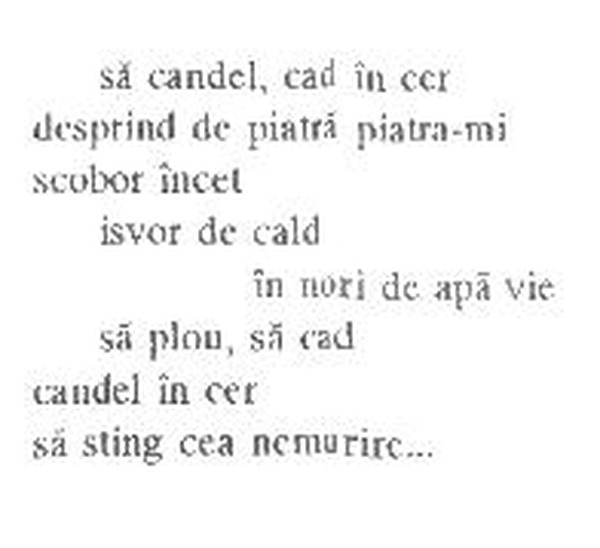
să candel, cad în cer
desprind de piatră piatra-mi
scobor încet
isvor de cald
  în nori de apă vie
să plou, să cad
candel în cer
să sting cea nemurire…
A small verse of becoming water. That I be a candle, that I fall in the sky — I unfasten from stone, my stone — I climb down slowly — spring of warm — in clouds of living water — that I rain, that I fall — candle in the sky — that I quench that immortality… A single sentence in seven lines, the speaker becoming candle, water, rain, falling, quenching. The closing image — quenching immortality — is one of the cleanest theological gestures in the book. The verse ends by snuffing out what should not be put out. (Higher confidence; the imagery is clear, the syntax single-sentence.)
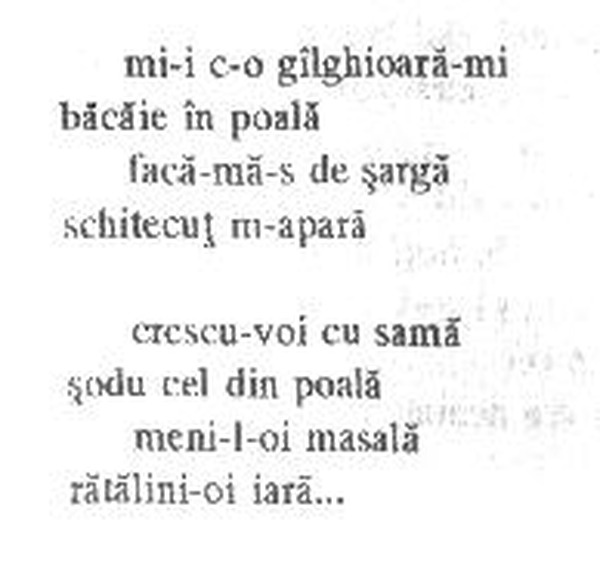
mi-i c-o gîlghioară-mi
băcăie în poală
facă-mă-s de șargă
schitecuț m-apară

crescu-voi cu samă
șodu cel din poală
meni-l-oi masală
rătălini-oi iară…
A verse of cradling. I’ve got a little gurgler — he’s plashing in my lap — let me be made of soft yellow — let a small mark keep me safe. Second stanza: I’ll grow him with care — the rascal one from my lap — I’ll appoint him a banquet — I’ll set him out again… A clear lullaby. A small baby (or fledgling, or some loved small thing) in the speaker’s lap is being promised growth and a feast. The voice is plainly tender. (Medium-high confidence; one of the warmest verses in the book.)
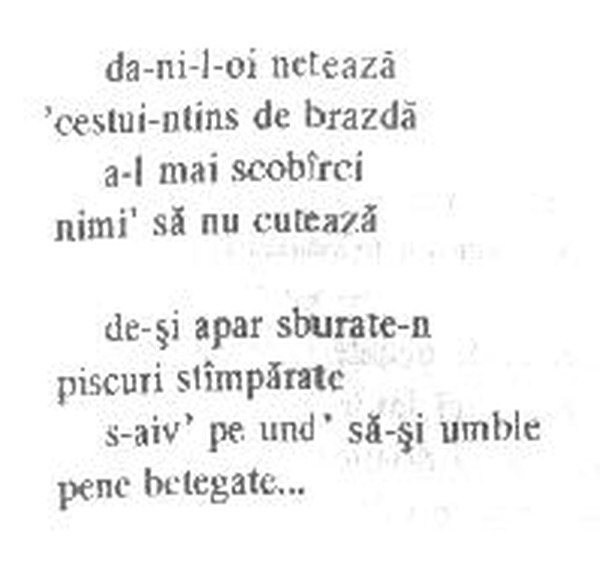
da-ni-l-oi netează
'cestui-ntîns de brazdă
a-l mai scobîrci
nimi' să nu cuteaza

de-și apar sburate-n
piscuri stîmpărate
s-aiv' pe und' să-și umble
pene betegate…
A verse of taming a furrow. Let us give it to him smoothed out — this newly turned of furrow — let no one dare to scoop it crooked. Second stanza: even if there appear flown-up pieces of broken summit, let them have somewhere to wander — pens of begotten things. A short land-care verse. The speaker is asking that a freshly turned furrow be kept smooth and untouched, even if pieces fall off it; let the pieces have their own place to scatter. A patient verse about not disturbing what’s in process.
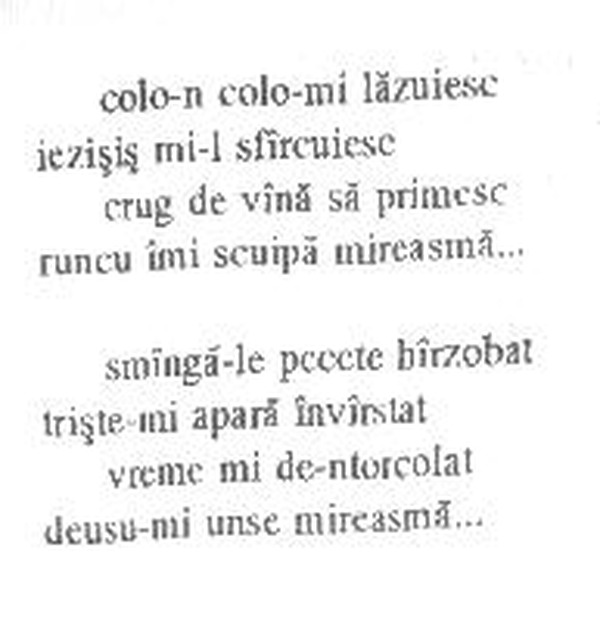
colo-n colo-mi lăzuiesc
iezișiș mi-l sfîrcuiesc
crug de vînă să primesc
runcu îmi scuipă mireasmă…

smîngă-le poceté hîrzobat
triste-mi apară învîrtat
vreme mi de-ntorcolat
deusu-mi unse mireasmă…
A verse of small spaces. Out there, here, I dig myself a little place — I shimmy-quick the little spike — I receive a vein-strength — the field spits fragrance at me… Second stanza: the gathered tatters scrap-wadded — sadness appears whirled up — time for me of unwinding — the unguent of fragrance on me… A verse of small spaces and small fragrances: digging, receiving, getting tangled, getting anointed. Closes with unse mireasmă — anointed fragrance — the same word used twice in the verse, opening and closing it.
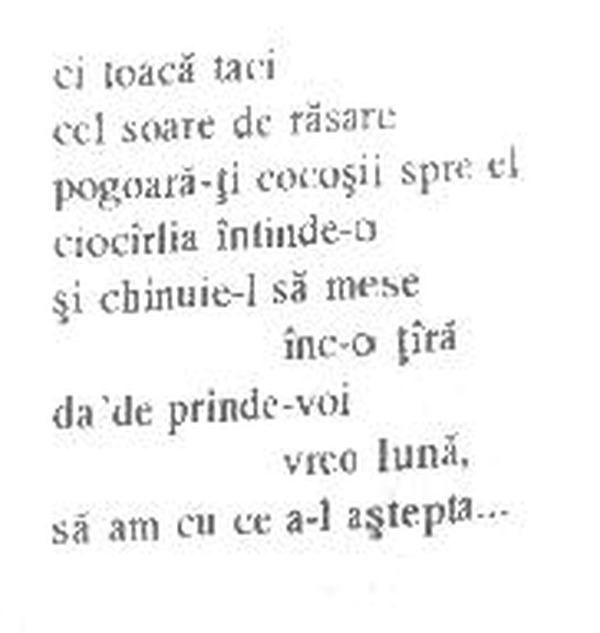
ci toacă taci
cel soare de răsare
pogoară-ți cocoșii spre el
  ciocîrlia întinde-ți
și chinuie-l să mese
    înc-o țîră
da'de prinde-voi
    vreo lună,
să am cu ce a-l aștepta…
A verse of waiting for the dawn. Quiet, you bell, be still! — that rising sun — bring down its roosters down to it — stretch the lark out for me — and torment it onto a table — just a little while more — if I’ll find — some moon — so I’ll have something to await him with… A verse of nervous preparation for the sun’s arrival. The voice is part child, part curmudgeonly host wanting the right offering on the table. The verse is alive with small kitchen actions stretched between dawn-waiting and full daylight.
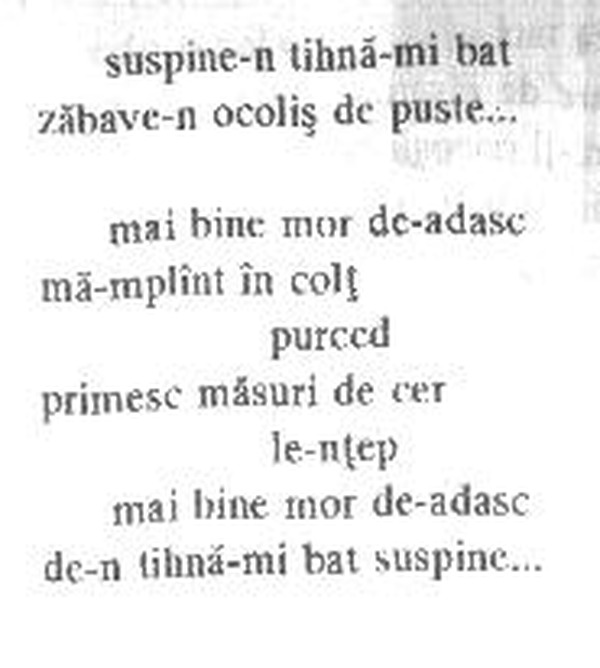
suspine-n tihnă-mi bat
zăbave-n ocoliș de puste…

mai bine mor de-adasc
mă-mplint în colț
  purced
primesc măsuri de cer
  le-nțep
mai bine mor de-adasc
de-n tihnă-mi bat suspine…
A verse of preferring death to disquiet. Sighs beat at me in stillness — lingering in the dodging of empties… Then: better that I die at once — I drive myself into a corner — gone — I receive measurements of sky — I prick them — better that I die at once — for in stillness sighs beat at me… A short verse of weariness that loops — the first line returns as the last, slightly reordered. The speaker has been worn down to the wish for an ending and frames it as a small private chant. (Medium confidence; the loop-form is the verse’s shape.)
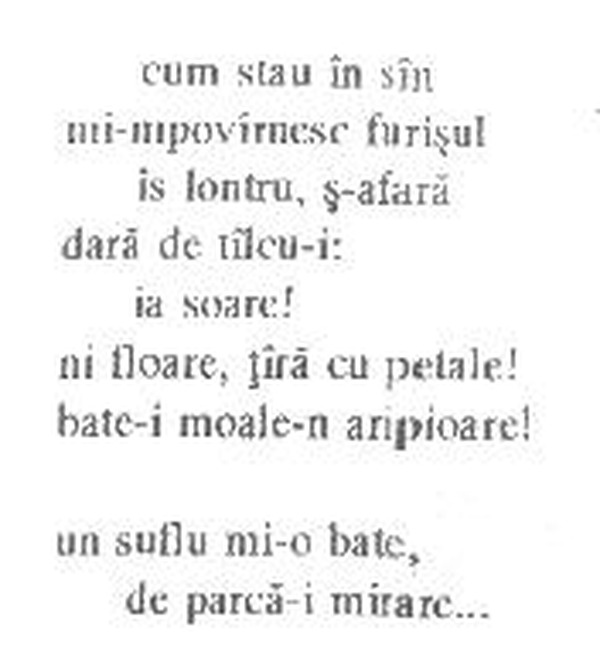
cum stau în sîn
mi-mpovîrnesc furișul
îs lontru, ș-afară
dară de tîcu-i:
  ia soare!
ni floare, țîră cu petale!
bate-i moale-n aripioare!

un suflu mi-o bate,
de parcă-i mirare…
A verse of sun-asking. How I sit in my own bosom — I lift up my stealthy little thing — both inside and out — but from the silent one: Then a shouted imperative: ia soare! — take the sun! No flower, just a little with petals — beat them softly on its wings! Closes: a breath beats at me — as if from astonishment… A small verse about asking the silent one to take the sun, with a flower-offering. The voice tries on a high-formal liturgical register and then comes back down to plain wonder.
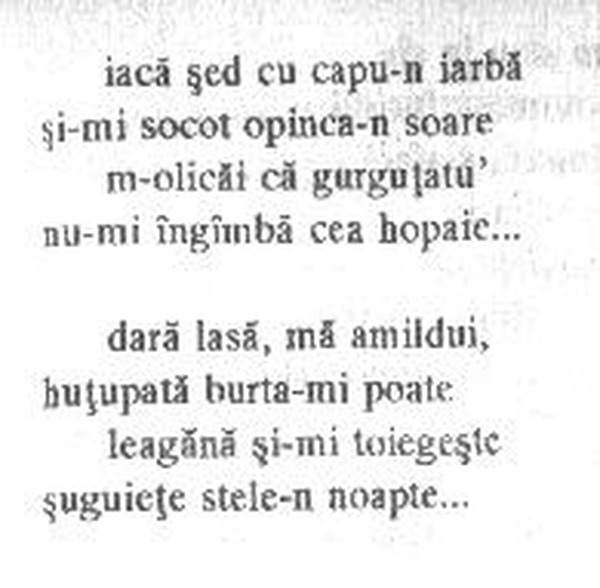
iacă șed cu capu-n iarbă
și-mi socot opinca-n soare
m-olică' că gurgățatu'
nu-mi îngîmbă cea hopaie…

dară lasă, mă amîldui,
huțupată burta-mi poate
leagănă și-mi toiegește
șuguiețe stele-n noapte…
A verse of a body lying in grass. Look at me sitting with my head in the grass — and counting my own foot-skin in the sun — I gather myself because that pebble — doesn’t fold over my little jaw… Second stanza: but never mind, I’ll lull myself — my belly’s ample — rocks me and steadies me — suckle me, stars in the night. A verse spoken from a body lying in grass, half-dozing, attentive to a pebble and a foot and a belly. Pastoral, slightly ironic, completely physical. (Higher confidence; one of the clearer body-verses.)
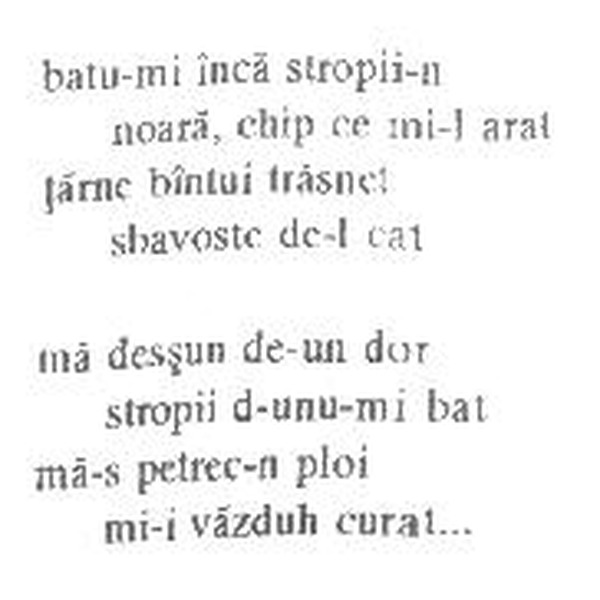
batu-mi încă stropii-n
noară, chip ce mi-i arat
țărne bîntui trăsnet
sbavoste de-l cat

mă desgun de-un dor
  stropii d-unu-mi bat
mă-s petrec-n ploi
  mi-i văzduh curat…
A verse of being soaked. The drops still beat me in — into mud, however it looks to me — the field driven by thunder — a savagery if I count it… Second stanza: I unfasten from a longing — the drops one by one beat me — let me pass through the rains — my air is clean. A simple, almost grateful storm-verse. The speaker is being beaten by rain and discovers in the second stanza that this is what was wanted: cleaning. The closing line — mi-i văzduh curat , my air is clean — is one of the clearest declarations in the book.
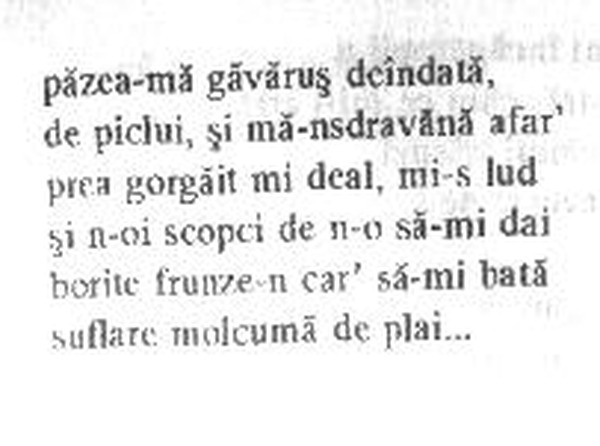
păzca-mă găvăruș dcindată,
de pîclui, și mă-nsdruvănă afar'
prea gorgăit mi deal, mi-s lud
și n-oi scopci de n-o să-mi dai
borite frunze-n car' să-mi bată
suflare molcumă de plai…
A short verse of asking to be saved. Save me, my dear, at once — from the fog, drag me out into the open — too much I’ve sunk, my dale, I’m crazed — and I won’t come round if you don’t bring me — some withered leaves in which let me be struck — a soft breath of meadow… A single sentence in six lines, the speaker pleading with a familiar (a friend? a wife? a place?) to drag him out of fog and lay him in leaves where a breath of meadow can find him. The voice is urgent but trustful — the addressee will know what to do. (Medium confidence.) 21 m-abuă vîntu-mi d-aburare, de tuturindere alăturea, d-acole să stăvir în toale: oi desclipi cît cîtilin mă-ncapă vreo nădaie oi ințîgla netot spre niscai zare ș-oi împupi străpsorul să mi-l vasă mărunt, măruntul 9 words flagged for review
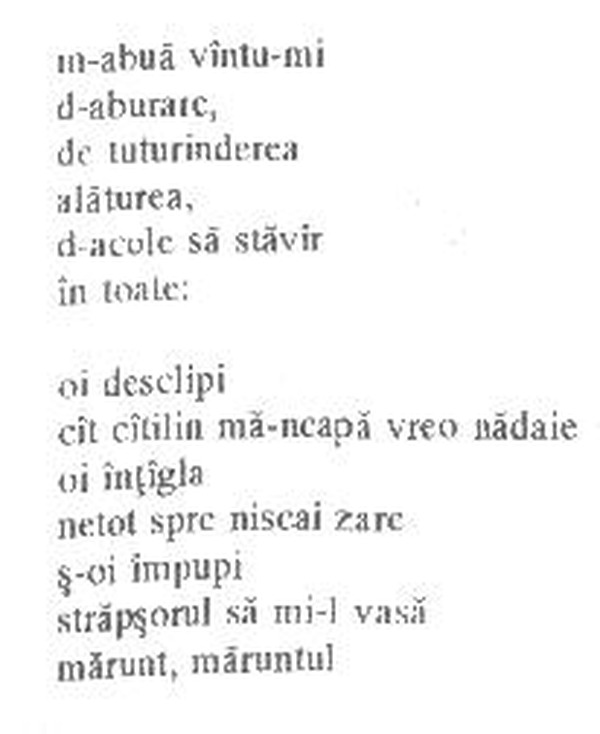
m-abuă vîntu-mi
d-aburare,
de tuturindere
alăturea,
d-acole să stăvir
în toale:

oi desclipi
cît cîtilin mă-ncapă vreo nădaie
oi ințîgla
netot spre niscai zare
ș-oi împupi
străpsorul să mi-l vasă
mărunt, măruntul
A long verse of becoming wind. The wind exhales me — of evaporation — from the dim-edged places — alongside — from there to settle — entirely: Then: I’ll part the foam — as much as a little while may catch — I’ll thread myself — foolish toward some glance — and bud out — the little spine to vex me — tiny, the small one. A verse of dissolution and re-emergence: the speaker becomes wind, parts foam, threads toward a glance, buds back out as a small thorn. One of the most plainly mystical verses in întru. (Medium-low confidence on individual lines; the dissolve-and-resurface motion holds it together.)
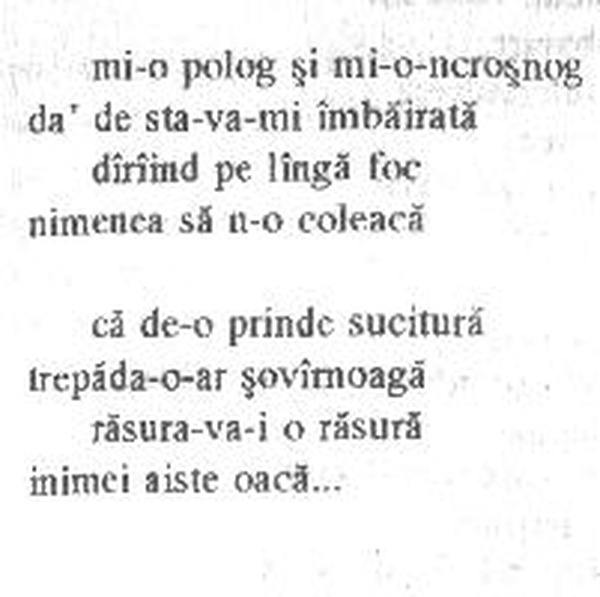
mi-o polog și mi-o-ncrosnog
da' de stava-mi îmbăirată
dîrînd de lîngă foc
nimenca să n-o coleacă

că de-o prinde sucitură
trepăda-o-ar șovîrnoagă
răsura-va-i o răsură
inimei aiste oacă…
A short verse of folk-protection. I wrap him and I bundle him — even if my coupling is bound — trembling near the fire — let no one come near her… Second stanza: if a cramp catches her — let it tread away tipsy — let it draw and redraw — this heart, this little oak-fruit. A verse of guarding someone — a child? a wife? — from a cramp or fever near the fire. The closing image inimei aiste oacă (this heart, this little acorn) is a household endearment. A small protection-charm. (Medium confidence.)
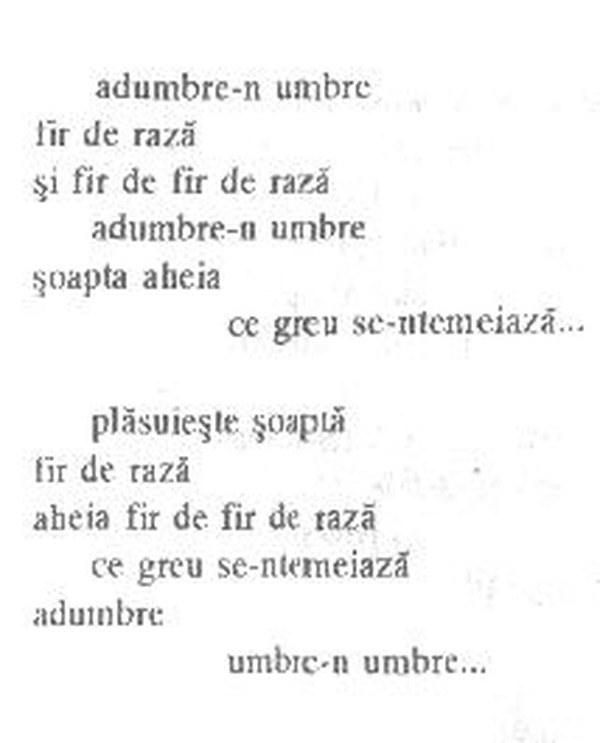
adumbre-n umbre
fir de rază
și fir de fir de rază
adumbre-n umbre
șoapta aheia
ce greu se-ntemeiază…

plăsuiește șoaptă
fir de rază
aheia fir de fir de rază
ce greu se-ntemeiază
adumbre
  umbre-n umbre…
A verse of shadow and whisper, formally doubled. Shade-in-shade — thread of light — and thread of thread of light — shade-in-shade — the whisper of that one — how hard it founds itself… Second stanza: the whisper resounds the whisper — thread of light — that one ’s thread of thread of light — how hard it founds itself — shade — shadows-in-shade… A verse where every image returns reversed in the second stanza — shade in shade closes as shadows in shade ; thread of light becomes thread of thread of light . A formal exercise in chiasmus. Beautiful as object, less interpretively rich than other verses — it is its own structure. (Higher confidence; the form is the content.)
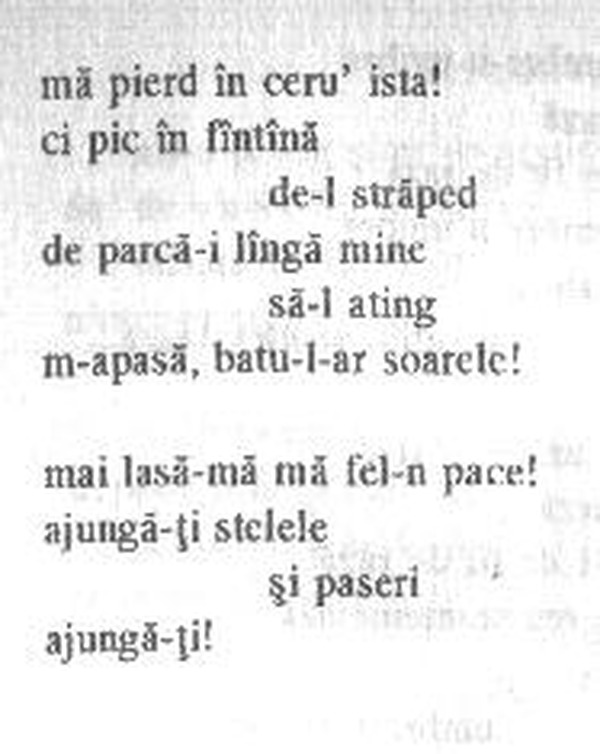
mă pierd în ceru' ista!
ci pic în fîntînă
  de-l străped
de parcă-i lîngă mine
  să-l ating
m-apasă, batu-l-ar soarele!

mai lasă-mi mă fel-n pace!
ajungă-ți stelele
  și păseri
ajungă-ți!
A verse of being overwhelmed by the sky. I’m lost in this sky! — I drop into the well — let me pierce it — as if it’s right next to me — let me reach it — it presses on me, may the sun strike it! Second stanza: just leave me a little in peace! — let your stars do — and your birds — let them do! A verse of being smothered by too much heaven and asking for a moment of just — nothing. The voice is exasperated, almost domestic. The closing ajungă-ți! — let it be enough — is one of the funniest lines in the book. (Higher confidence.)
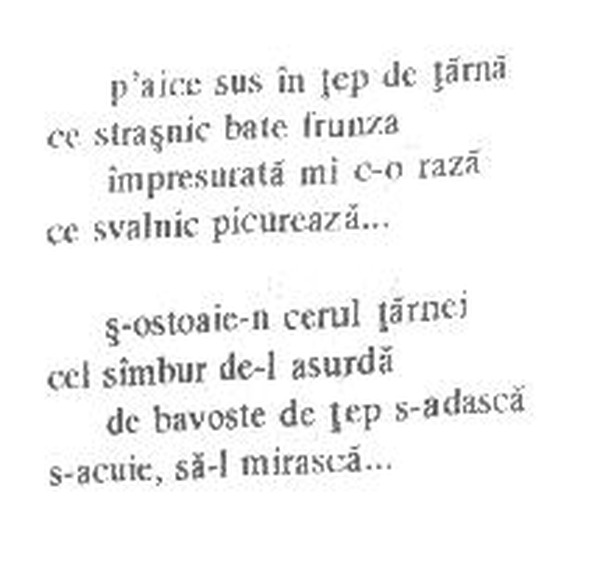
p'aice sus în țep de țărnă
ce strașnic bate frunza
împresurată mi c-o rază
ce svalnic picurează…

ș-ostoaie-n cerul țărnei
cel sîmbur de-l asurdă
de bavoste de țep s-adască
s-acuie, să-l mirască…
A verse of high pasture. Up here, in the thumb of dirt — how the leaf is beaten — surrounded by a single ray — how brilliantly it drips… Second stanza: and it settles in the sky of dirt — the seed that deafens it — of glittering, where the dirt would settle — let it ripen, let it ferment… A verse about high country and the seed in it. The phrase ceriul țărnei — the sky of dirt — turns earth into heaven for one small word. A patient verse on slow ripening. (Medium-high confidence; the figure of earth-as-sky is the load-bearing image.)
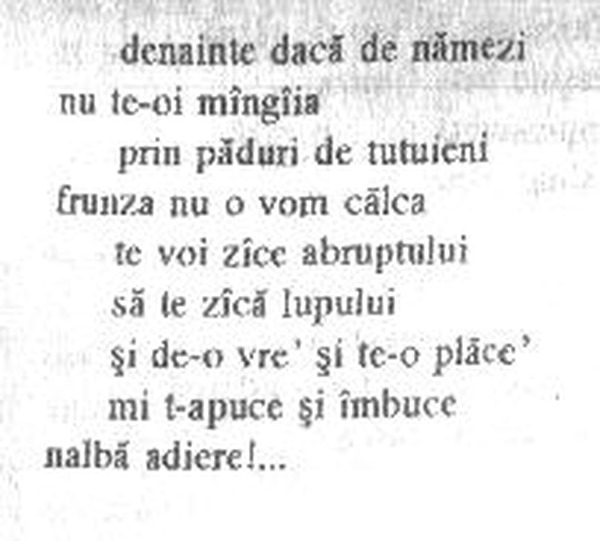
denainte dacă de nămezi
nu te-oi mîngîia
prin păduri de tutuieni
frunza nu o vom călca
te voi zice abruptului
să te zică lupului
și de-o vre' și te-o plăce'
mi t-apuce și îmbuce
nalbă adiere!
A verse of preferment refused. Before, if it’s noon — I will not soothe you — through forests of yew-trees — we will not tread the leaf — I will tell you to the broken one — let the wolf speak you — and if he wants to and likes you — let him take you and devour you — mallow-flower, you! A single-sentence imprecation, delivered to a beloved with strange tenderness — I won’t soothe you; let the wolf eat you; mallow-flower! Reads as a child’s teasing curse made permanent, or as a folk-incantation where being eaten is a fate the beloved is being released to. (Higher confidence; the verse is one long sentence.)
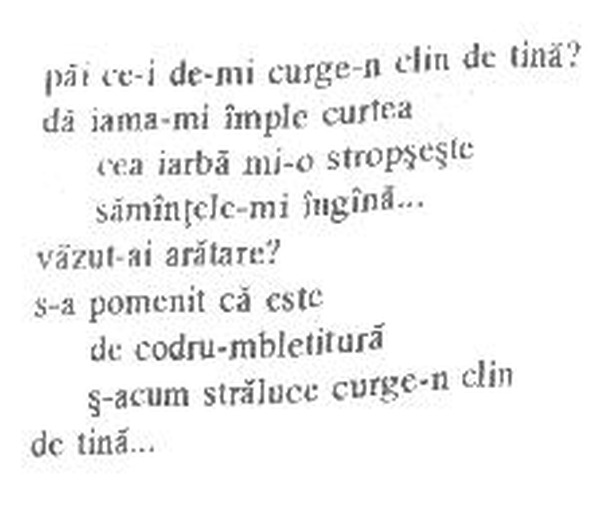
păi ce-i de-mi curge-n clin de tină?
dă iama-mi împle curtea
  cea iarbă mi-o stropșește
  sămîn(tele)-mi îngînă…
văzut-ai arătare?
s-a pomenit că este
  de codru-mbletitură
ș-acum strălucie curge-n clin
de tină…
A verse of mud-coming-into-the-yard. So what is it flowing into my muddy slope? — give a swarm, fill the yard — that grass it’s flattening — the (seeds) it’s mumbling — did you see the apparition? Second stanza: it’s come up that this — is the rumbling of the forest — and now it streams flowing on the muddy slope… A clear narrative verse: something has flowed down out of the woods into the speaker’s yard, mumbling and flattening grass, and the speaker has identified it as the forest’s own thunder coming to visit. (Higher confidence; the literal action is unusually clear.)
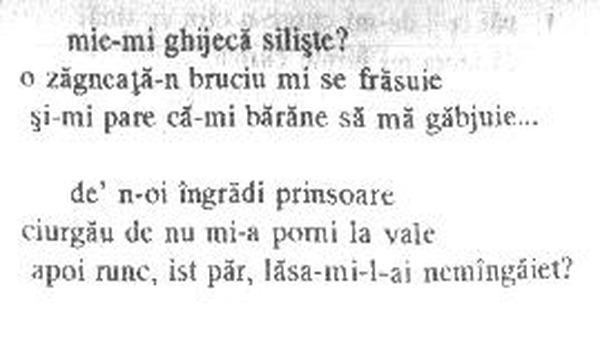
mie-mi ghijecă siliște?
o zăgnață-n bruciu mi se frăsuie
și-mi pare că-mi bărîne să mă găbjuie…

de' n-oi îngrădi prinsoare
ciurgău de nu mi-a porni la vale
apoi runc, ist păr, lăsa-mi-l-ai nemîngăiet!
A verse of being startled. Does it seem to me a clearing? — a magpie’s clattering in the thicket frightens me — and it seems they’re cracking branches to come grab me… Second stanza: if I don’t fence off a snare — the gully if it won’t start for me down the valley — well then run, this pear-tree — you’ll have left me untended! A short verse of forest-fear — the speaker startled by birds and breaking branches in the brush, and warning a pear-tree that he’ll abandon it if it doesn’t do its part. Voice tipped slightly funny. (Medium confidence.)
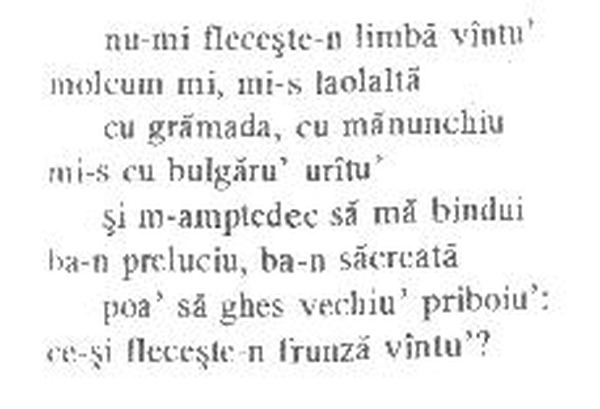
nu-mi flecește-n limbă vîntu'
molcum mi, mi-s laolaltă
cu grămada, cu mănunchiu
mi-s cu bulgăru' urîtu'
și m-amptedee să mă bindui
ba-n preluciu, ba-n săcrcată
  poa' să ghes vechiu' priboiu',
ce-și flecește-n frunză vîntu'?
A verse of wind that won’t come into the tongue. The wind doesn’t flicker on my tongue — gentle in me — I’m altogether — with the crowd, with the bundle — I’m a clump of an ugly — and I bite and embed myself — sometimes in the meadow, sometimes in the brittle — could it be I sense the old wanderer? — what is it that flickers on the leaf the wind? A verse that asks itself a question and lets it hang. The wind that won’t come into speech, but does come into the leaf. (Medium confidence.)
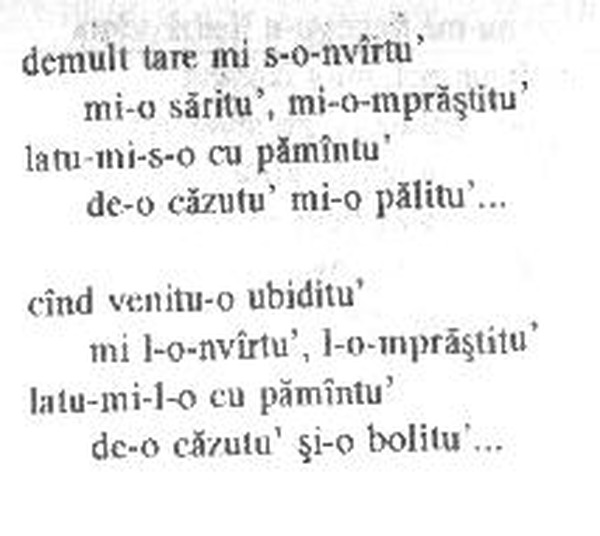
demult tare mi s-o-nvîrtu'
mi-o săritu', mi-o-mprăștitu'
latu-mi-s-o cu pămîntu'
de-o căzutu' mi-o pălitu'…

cînd venitu-o ubiditu'
mi-l-o-nvîrtu', l-o-mprăștitu'
latu-mi-l-o cu pămîntu'
de-o căzutu' și-o bolitu'…
A verse of double overturn. Long ago he overturned me — he tossed me, he scattered me — he flattened me with the earth — if he fell, he struck me… Second stanza, the same pattern: when the cripple came — he overturned me, he scattered me — he flattened me with the earth — if he fell, he also sickened me… Two identical stanzas, two figures — an earlier he , and the cripple who came later. Each did the same violence to the speaker. The verse is a small structural complaint about how the same thing keeps happening. (Higher confidence; the parallel form holds it.)
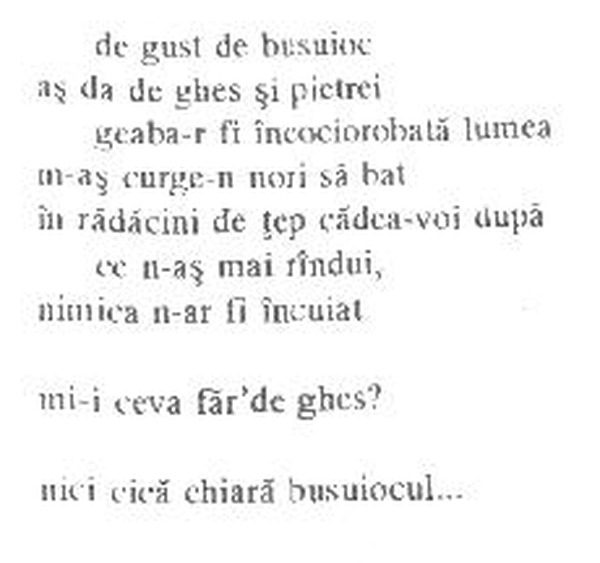
de gust de busuioc
aș da de ghes și pietrei
geaba-r fi încociorobată lumea
n-aș curge-n nori să bat
în rădăcini de țep cădea-voi după
ce n-aș mai rîndui,
nimica n-ar fi îneuiat

mi-i ceva făr' de ghes?

nici cică chiară busuiocul…
A verse of basil. For the taste of basil — I’d give all I have to the stone — in vain would the world be all churned up — I’d not be running in clouds to beat — I’d fall away into roots of soil — for what wouldn’t I do — nothing would be denied me… Then the question: Is there anything without taste? And: not even, they say, basil itself… A philosophical-folk verse: nothing the speaker would not do for basil, but in the end — even basil itself is said to be tasteless. The verse closes on a denial of its own opening. (Higher confidence; the argument is unusually visible.) 32 spre ferece asudă muțenia mi din lespezi mă parcă asurzește blestăm cătat de veste să-mi balsăm oful mi-nsîimui lut în pîntec ci sfarm în chipuri cea tăcere, tuciui: du-mi măi pîrău legarea du-mi piatrele bătute le svîrcole, le răticeste le poartă-n unde-n veci, aiurea… 12 words flagged for review
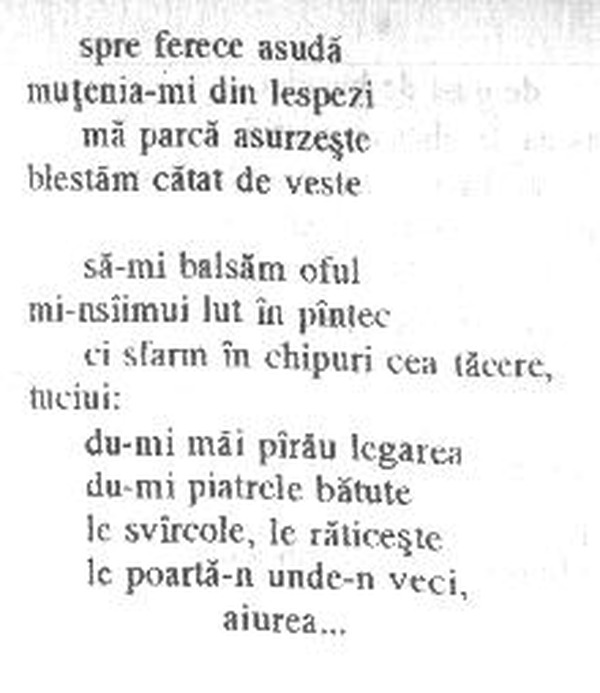
spre ferece asudă
muțenia mi din lespezi
mă parcă asurzește
blestăm cătat de veste

să-mi balsăm oful
mi-nsîimui lut în pîntec
ci sfarm în chipuri cea tăcere,
tuciui:
du-mi măi pîrău legarea
du-mi piatrele bătute
le svîrcole, le răticeste
le poartă-n unde-n veci,
    aiurea…
A long imprecation against silence. Toward delight sweats — my muteness out of slabs — me, it seems, deafens — a curse hunted by news… Then: let me balm my sigh — clay sets in my belly — I shatter into shapes that silence, you wretch: — bring me yet brooks for binding — bring me beaten stones — sling them, tear them — carry them in waves forever — aiurea … (somewhere) A verse against muteness, calling for brooks and beaten stones to be slung and torn and carried away — the speaker undoes his own silence into a curse of running things. (Medium-high confidence; the verse’s feeling is strong, the precise relations less so.)
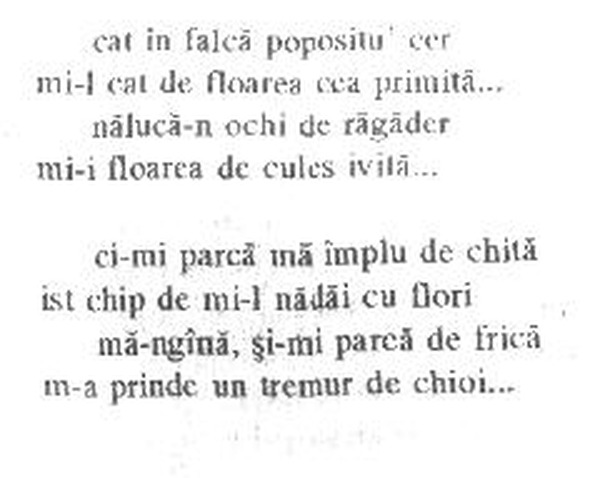
cat în falcă popositu' cer
mi-l cat de floarea cea primită…
nălucă în ochi de răgăder
mi-i floarea de cules ivită…

ci-mi parcă mă împlu de chită
ist chip de mi-l nădăi cu flori
mă-ngîna, și-mi parcă de frică
m-a prinde un tremur de chioi
A verse of the inviting flower. I lie in the gully, sky settled — I lie about it from a primal flower — an apparition in my eye like a kerchief-edge — my flower of gathering is shown. Second stanza: and it seems to fill me with a sip — this shape so I might cluster with flowers — coiled to me, and it seems out of fear — a tremor of timid catches me up. A verse of the speaker lying somewhere, watching a flower-image and feeling himself almost gathered up by it. The closing tremor is a flinch the verse names directly. (Medium confidence.)
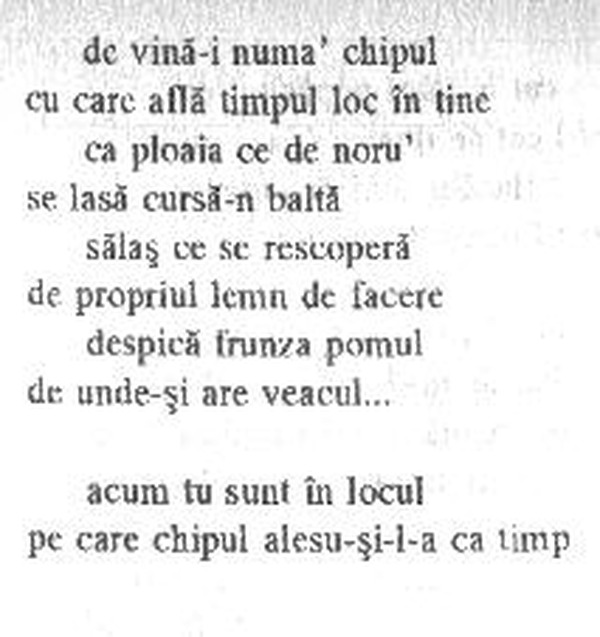
de vină-i numa' chipul
cu care află timpul loc în tine
ca ploaia ce de noru'
se lasă cursă-n baltă
sălaș ce se rescoperă
de propriul lemn de facere
despică frunza pomul
de unde-și are veacul…

acum tu sunt în locul
pe care chipul alesu-și-l-a ca timp
A verse of the source. It’s the figure alone that’s to blame — with which time finds room in you — like the rain that, from the cloud, settles itself into the pool — the shelter that uncovers itself — of its own wood of making — the tree splits the leaf — from where its age stands. Then: and now you are in the place — that the figure chose-itself-as time. The book’s most directly philosophical verse. The speaker tells the addressee: you are now where the shape has chosen itself as your time . Reads as the moment in the book where the poet states what the practice is. (Higher confidence; one of the clearest verses in întru.)
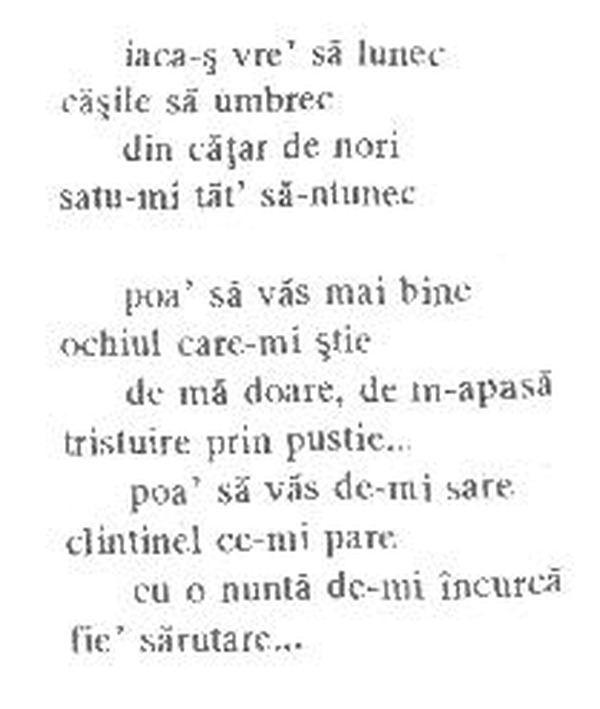
iaca-ș vre' să lunec
căsile să umbrec
din cățar de nori
satu-mi tăt s-ntunec

poa' să văs mai bine
ochiul care-mi știe
de mă doare, de m-apasă
tristure prin pustie…
poa' să văs de-mi sare
clintinel ce-mi pare
cu o nuntă de-mi încurcă
fie' sărutare…
A verse of the cloak of clouds. Look how I’d like to slip away — my houses to be shaded — from a heap of clouds — the whole village I’d darken. Second stanza: then I’ll see better — the eye that knows me — that aches for me, that presses me — sadly through wilderness… Third stanza: then I might see if my chimes leap — the little hammer that seems to me — with a wedding curling at me — let there be a kiss… A village-cosmic verse: under cloud-shadow, the speaker can see the eye that knows him, and a wedding-bell, and let there be a kiss. The voice is theatrical but tender. (Medium-high confidence.)
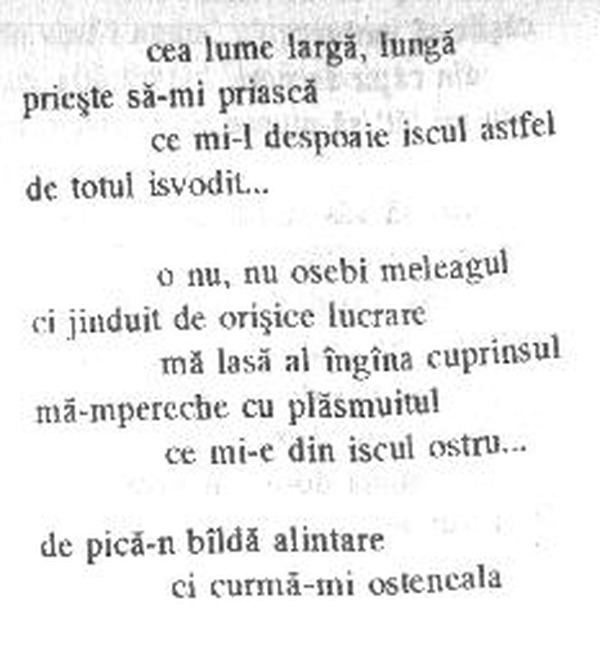
  cea lume largă, lungă
prieșe să-mi priască
ce mi-l despoaie iscul astfel
de totul isvodit…

o nu, nu osebi meleagul
ci jinduit de orișice lucrare
  mă lasă al îngîna cuprinsul
mă-mpereche cu plăsmuitul
  ce mi-e din iscul ostru…

de pică-n bîldă alintare
ci curmă-mi osteneala

de par nesață lacră
m-adapă-n nimereală

îu, vasă țîră
  te-nghesuie, te ntinde
și-stăinuie-mă-n chipuri
  să mes pînă mi-ajungă…
The book’s closing verse, two scans long. First page: That wide, long world — let it appear my friend — that strips the kernel from me thus — entirely uncovered… Then: oh no, do not single out the country — but yearned for by any labor — let me hum along with the surroundings — let me marry up with the shape — that is mine from the kernel within… Then: if it drips into a soothing puddle — please end my weariness… The verse on the page asks the world to stop singling out its country, asks to be married to whatever shape arises, asks for the soothing puddle to end the weariness. (Higher confidence; the closing tone is plain.)