
măiu — măiu!
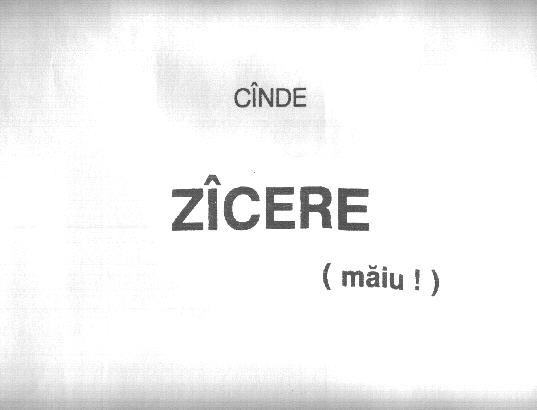
The village book — thirty-seven zîceri, populated with neighbors, hunter-shepherds, weddings, the dead. Each verse is shown as the scanned typewriter page, a transcription, and a reader’s note. Notes are interpretive prose, not translations; confidence varies and is flagged within individual notes. Recordings are forthcoming.
The book of the village.
If întru spoke the language of saints, măiu speaks the language of neighbors. Published a year later, it is the most populated of the three books — full of people, weather, work, and the particular comedy and grief of a place where everyone is known.
It opens on drumbeats and turns, almost at once, to a remembered company: cu noi vîntăreți buiaci — “with us, the hunters of the winds, drunk on summer.” These were the people who shared something with the poet and were mocked for it, and who showed up anyway. The whole book has that warmth of belonging to somewhere. A neighbor is cursed in the old folk cadence. A sick woman, her mouth gone dry, is watched over and shielded from the unseeing. A wedding is imagined; a banishment is imagined; the poet pictures himself driven out and burning, defiant, among the festival breads — only let her come and look.
And it has the village’s eye for the abandoned. One long verse walks past empty houses on a fading evening, naming each in a rolling, breathy list, and then lifts, at the very end, into a single startling image: a holiday moon set in a pendant, breaking out of the windows. That turn — from the derelict to the luminous, in one line — is măiu at its best.
The book is also where the title-word is finally spoken to directly, as if to a person. The poet talks to his own book, his own month, his own season of saying. măiu was the last book made while the poet still lived in Romania. It reads, now, like a long look at a world he was about to leave — every neighbor, every wall, held a little longer than necessary.
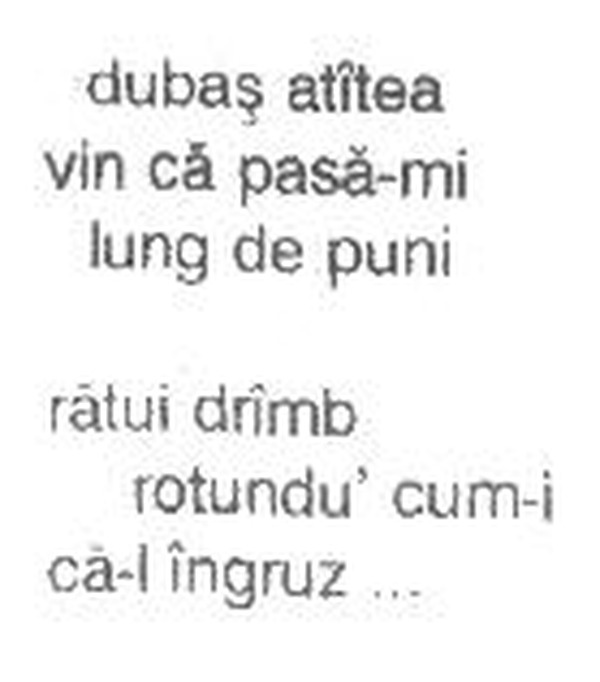
  dubaș atîtea
vin că pasă-mi
lung de puni

rătui drîmb
  rotundu' cum-i
că-l îngruz …
A short verse opens the book. Dubaș — the drummer, the one who beats the drum. Atîtea — so many. The drumbeats come; something passes through the speaker long as a stride. The second stanza turns to a held thing — rotundu’ cum-i , round as it is — that the speaker won’t let break, that he holds at the throat. The drumbeats outside, the round held thing inside. Opening verse of a book named for măiu — a name that may be a particle of address or a month or both at once.
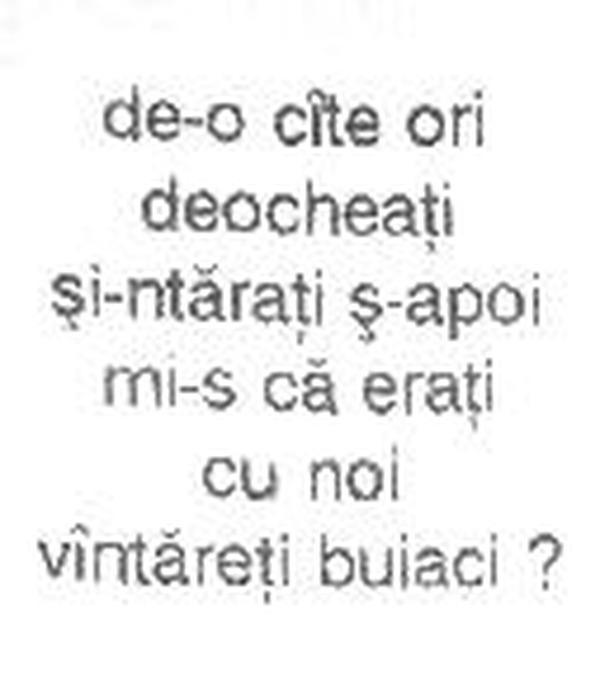
de-o cîte ori
deocheați
și-ntărați ș-apoi
mi-s că erați
cu noi
vîntăreți buiaci ?
A direct address to a remembered group. How many times you were taunted, embittered, and yet here you were — with us, hunter-shepherds, drunk on summer. The voice turns suddenly familiar, naming people who shared something with the speaker despite having been mocked for it. Vîntăreți buiaci — hunters of the winds, drunk on May — reads as a name the speaker would have given his own company in the place where this poetry came from.
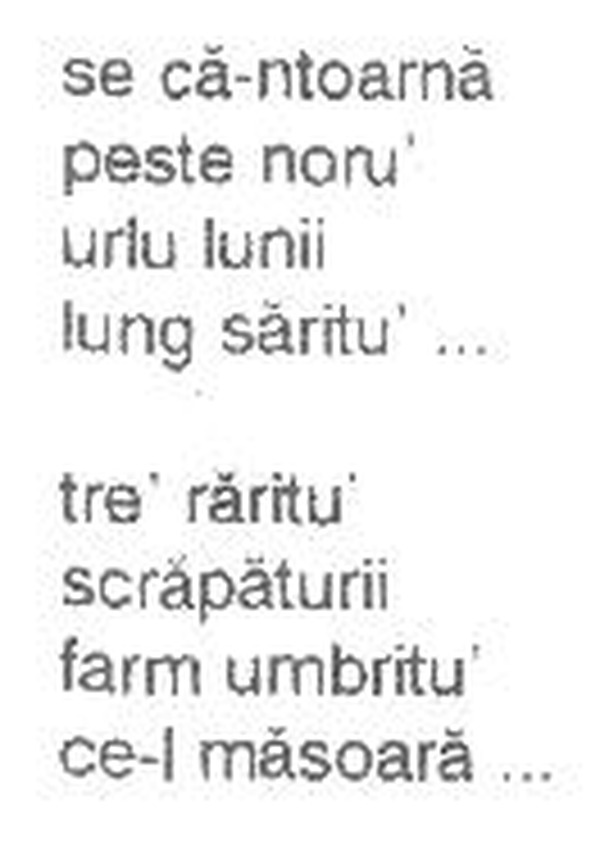
se că-ntoarnă
peste noru'
urlu lunii
lung săritu' …

tre' rărîtu'
scrăpături
farm umbritu'
ce-l măsoară …
The wind turns over the cloud, over the howl of the moon, and the long leap of it. Second stanza turns to scraping, scrabbling, the charm of shadow that measures itself. A brief two-stanza verse where the first stanza is sky-motion and the second is ground-scraping — the same wind seen from above and from below. (Medium confidence; some dialect words flagged.)
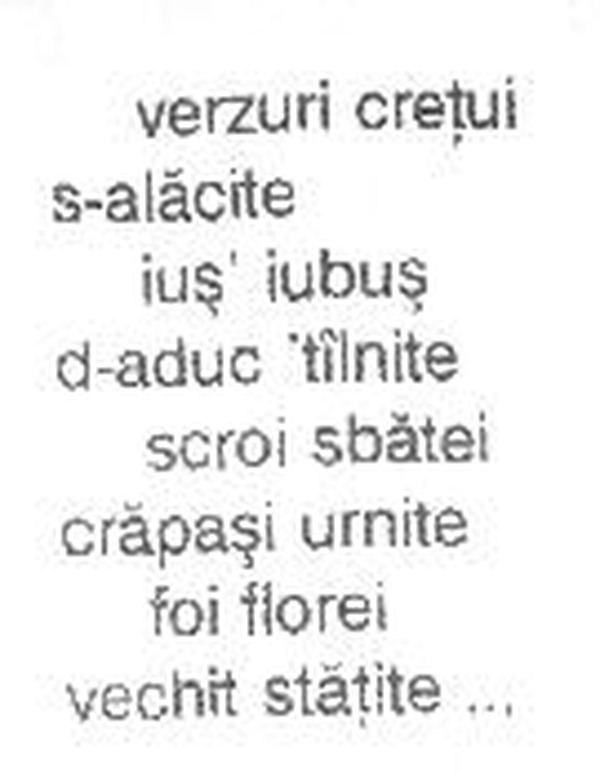
verzuri creței
s-alăcite
iuș iubuș
d-aduc 'tîlnite
scroi sbătei
crăpași urnite
foi florei
vechit stătite …
A verse made of compound adjectives ending in -ite . Verzuri creței s-alăcite — greenings curly and rusted-on. D-aduc 'tîlnite — that bring greetings. Scroi sbătei — trampled tracks. Crăpași urnite — cracks set in motion. Foi florei vechit stătite — old standing leaves of bloom. The verse is a small catalogue of stale, weathered, sun-stiffened things, named in a rolling rhyming cadence. (Lower confidence on individual words; the inventory of weathered greens is the load-bearing image.)
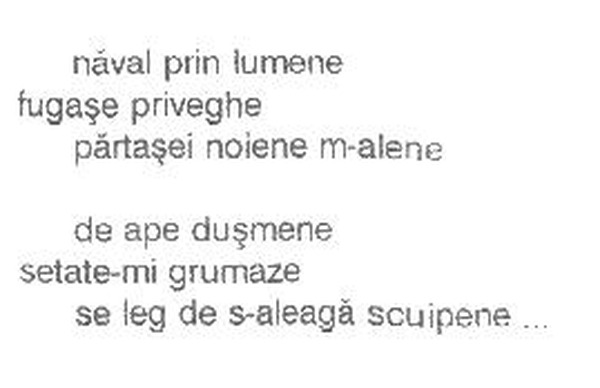
năval prin lumene
fugașe priveghe
  părtașei noiene m-alene

de ape dușmene
setate-mi grumaze
  se leg de s-aleagă scuipene …
A rush through the open, a hurried watching, sharing the snowdrifts with me. Second stanza: from waters that are enemies, from thirsting throats, they bind themselves to choose — spitfires. The verse moves quickly — through space, through company, through a hostile element. The closing word, scuipene , reads as something venomous or fire-spitting; the verse ends in the sharpness of whoever is binding themselves together against the bitter water. (Medium confidence.)
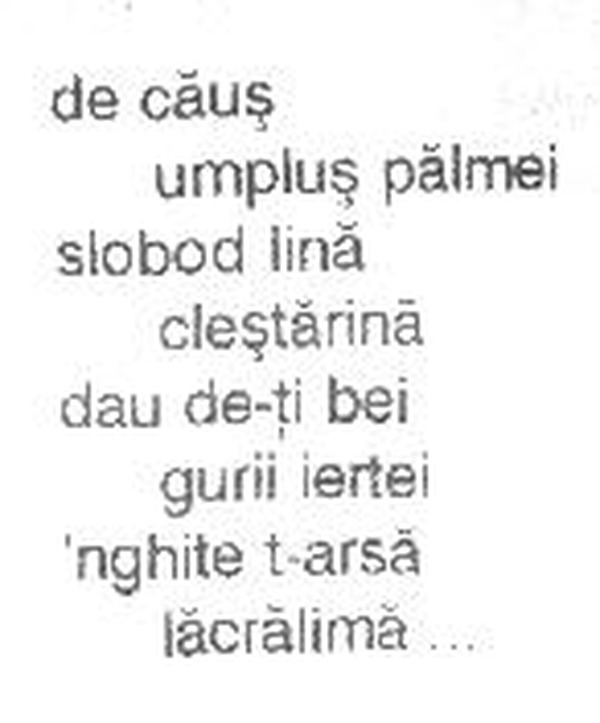
de căuș
  umpluș pălmei
slobod lină
cleștărină
dau de-ți bei
gurii iertei
'nghite t-arsă
lăcrămimă …
A scoop, a palm filled, a free smoothness, a glass clarity. The speaker gives a drink from the gift of the mouth; the throat swallows scorched, a tear-drop. A small, intimate verse of giving and being given a drink — the offering described in clear, sensual detail. The final image, lăcrămimă — a tear-drop — closes the verse on grief or on the salt that always follows such an offering.
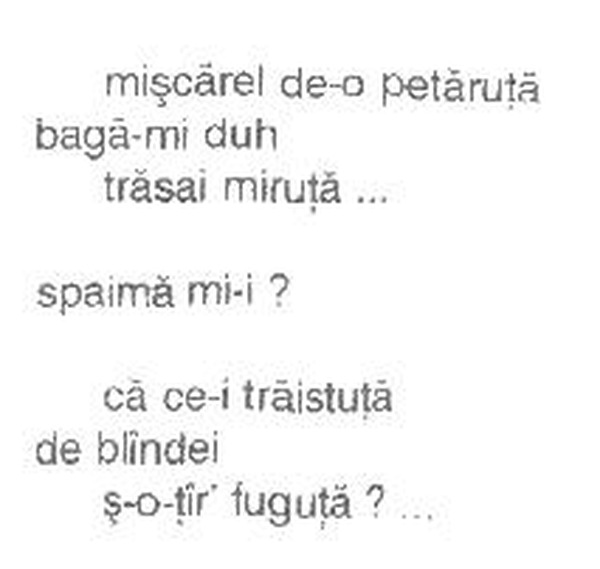
mișcărel de-o petăruță
bagă-mi duh
  trăsai miruță …

spaimă mi-i ?

  că ce-i trăistuță
de blîndei
ș-o-țîr' fuguță ? …
A small live thing — mișcărel de-o petăruță , a little stir of a butterfly. Bagă-mi duh — breathe into me. Trăsai miruță — you anointed me a little. Then: am I frightened? — well, what would I be, of one fearful, in such a small flight? A delicate, almost childlike verse about being touched briefly by a moth or butterfly. The voice is very tender; the rhetorical question ( spaimă mi-i ? ) does most of the work.
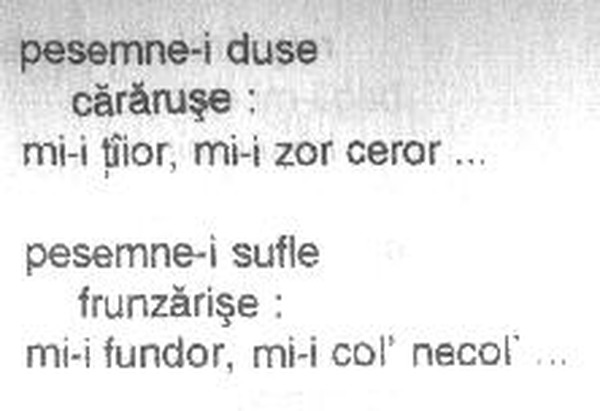
pesemne-i duse
cărărușe :
mi-i țîior, mi-i zor ceror …

pesemne-i sufle
frunzărișe :
mi-i fundor, mi-i col' necol' …
A verse of two parallel stanzas. Pesemne-i duse — perhaps they are gone (the small paths). Pesemne-i sufle — perhaps the leaves (their souls) are. Each stanza is a colon-statement: pathways gone, my little place lost; leaves gone, my corner-of-nowhere lost. A spare, formal verse about going and what gets lost when something is gone — the path of itself, the soul of the leaf. (Medium confidence; the colon-form is the verse’s shape.)
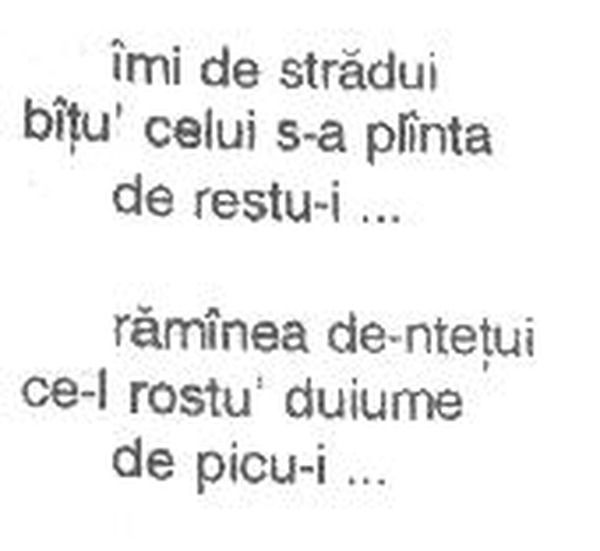
îmi de strădui
bîțu' celui s-a plînta
de restu-i

rămîna de-ntețui
cel rostu' duiume
de picu-i …
A verse of small effort. I struggle: that boy’s burst into tears from what was left him. Second stanza: and there remains for me to wedge it — the right one full of its little drop. A small private grief, described almost as a chore: someone has cried, something is left, and now there is the work of fitting the small thing in. The voice is plain and slightly worn. (Medium confidence.)
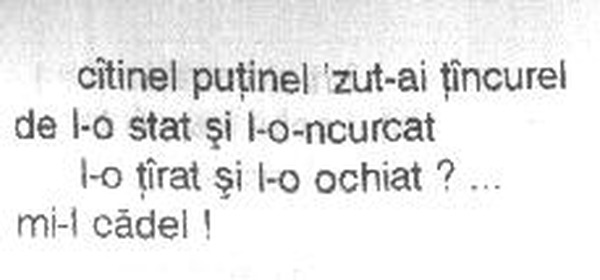
cîtinel puținel 'zut-ai țincurel
de l-o stat și l-o-ncurcat
  l-o țirat și l-o ochiat ? …
mi-l cădel !
A four-line verse of looking. Did you see, just a little, when one whip-crack tightened him, when one squeezed him crooked, when one branded him — when one fixed him with the eye? Closes: he fell for me! A short, vivid verse describing four small violences done to a third figure — tightening, crooked-squeezing, scorching, eyeing — that together brought him down. The closing exclamation, mi-l cădel ! , lands as both pity and triumph.
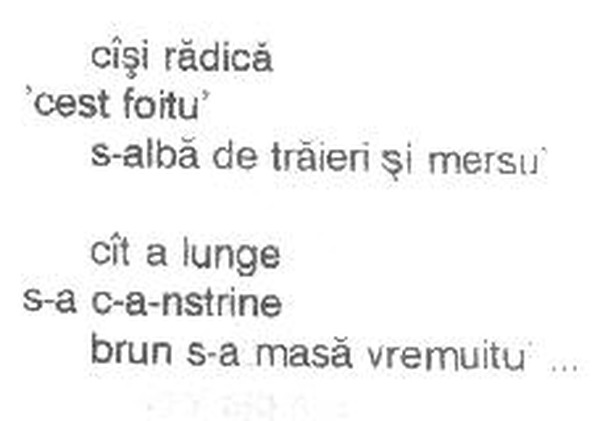
cîși rădică
'cest foitu'
  s-albă de trăieri și mersu'

cît a lunge
s-a c-a-nstrine
brun s-a masă vremuitu' …
Whoever is lifting 'cest foitu' — this leafy thing, this fluttering — let them have it whole of living and of going. Second stanza: and however far it lengthens, it has paled, gone darker, brown it has set on time. A verse about something the speaker hands off — let whoever takes it up have the whole of it — and then watches lengthen and pale and turn brown with time. Reads as a giving-away of a small leaf-thing whose color goes over to the next owner. (Medium-low confidence.)
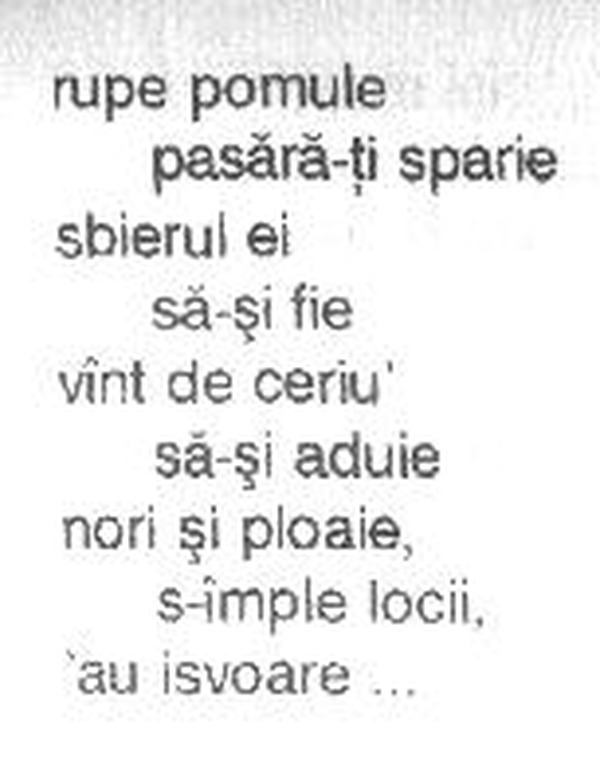
rupe pomule
pasără-ți sparie
sbierul ei
să-și fie
vînt de ceriu'
să-și aduie
nori și ploaie,
s-imple locii,
'au isvoare …
A direct address: break the tree, frighten your bird . Sbierul ei — the bird’s scream — let it be wind from the sky, let it gather clouds and rains, fill places, find springs . A short imperative verse: shake the tree, the bird’s cry becomes weather, and what was domestic becomes a watershed. The verse moves outward in one breath, from one tree to all the springs.
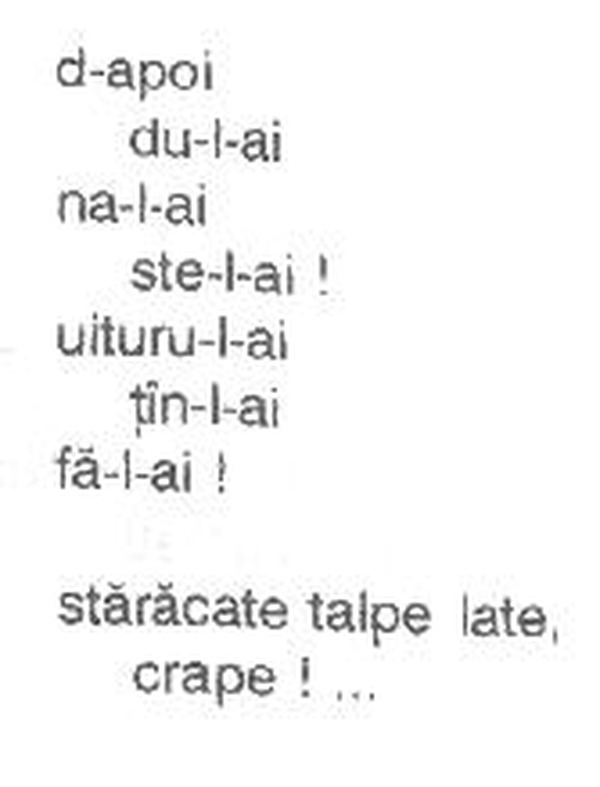
d-apoi
  du-l-ai
na-l-ai
    ste-l-ai !
uituru-l-ai
    țîn-l-ai
fă-l-ai !

stărăcate talpe late,
  crape ! …
A verse of imperatives ending in -l-ai : du-l-ai, na-l-ai, ste-l-ai, uituru-l-ai, țîn-l-ai, fă-l-ai . Take him, here’s him, set him, forget-thou-him, hold him, make him. The verse is structured almost entirely as commands in the second-person past-tense form, addressed to a you about a him . The closing line breaks the pattern: stărăcate talpe late, crape ! — wretched flat soles, may they crack! The verse is short and sharp — the closing curse landing after the imperatives.
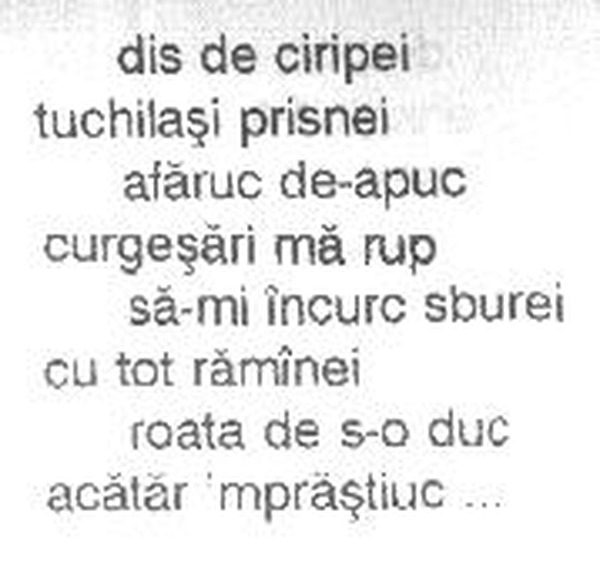
dis de ciripei
tuchilași prisnei
afăruc de-apuc
curgeșări mă rup
să-mi încurc sburei
cu tot rămînei
roata de s-o duc
acătăr 'mprăștiuc …
A morning — dis de ciripei , early at chirp-time. Little quail in the dew. Hurried de-apuc . The speaker is rushed by streams of water, has to load up the flock, drive the wheel. Acătăr 'mprăștiuc — like that I scatter-flee. A verse of country morning — chirping, dew, scrambling to gather and go — written in a hurry that the syntax reproduces. The voice is rural, working, slightly out of breath. (Medium confidence; the working-morning is clearer than the precise verbs.)
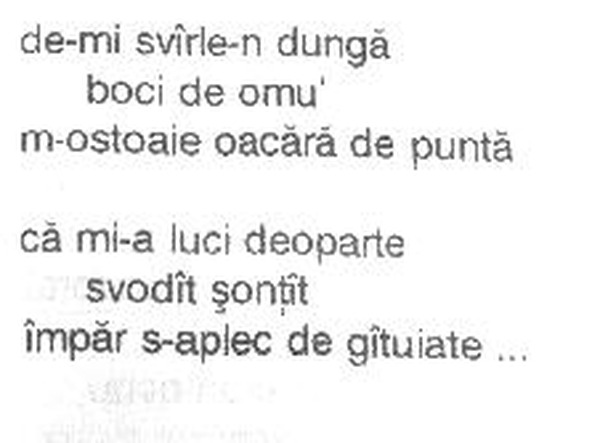
de-mi svîrle-n dungă
boci de omu'
m-ostoaie oacără de puntă

că mi-a luci deoparte
  svodit șonțit
împăr s-aplec de gîtuiate …
De-mi svîrle-n dungă — if they fling me to the side. Boci de omu' — men’s wails. M-ostoaie oacără de puntă — he stays me, a darkness of bridge. Second stanza: a far-off glint, an unstaying small thing, the speaker bent forward as if throttled. A short verse about being thrown sideways and stopped by something dark — with a glint in the distance the speaker bends toward, half-suffocating. (Medium-low confidence; the violence is visible, the precise relations less so.)
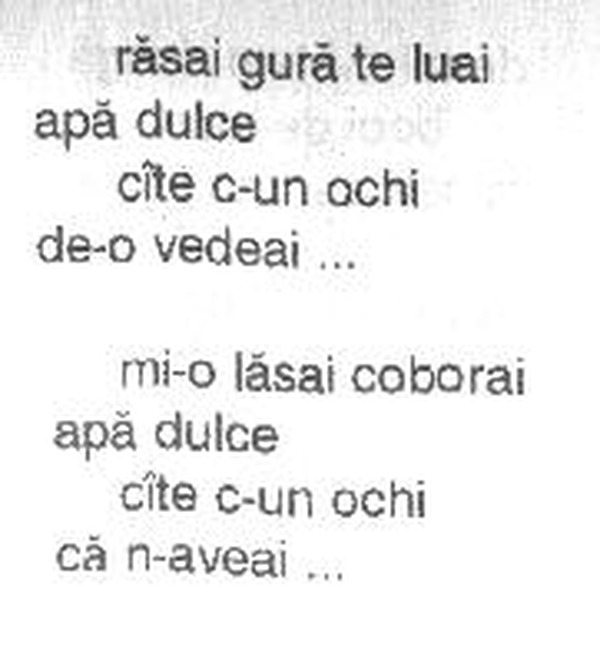
răsai gură te luai
apă dulce
  cîte c-un ochi
de-o vedeai …

  mi-o lăsai coborai
apă dulce
  cîte c-un ochi
că n-aveai …
A small parallel verse of two stanzas. You rose to my mouth, you took me — sweet water — from time to time with an eye — if you saw it. Second stanza: I let her be, I went down — sweet water — from time to time with an eye — because you had none. The verse turns on the eye that is given and then withheld, and on the rising and the going-down. Two short courtships, the second a quiet retreat. A clearer verse, more anchored in standard Romanian than most.
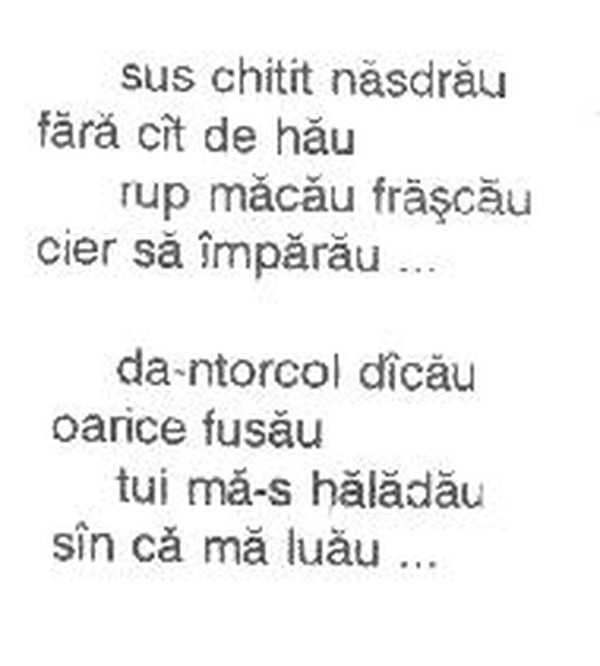
sus chitit năsdrău
fără cît de hău
rup măcău frășcău
cier să împărau

da-ntorcol dîcău
oarice fusău
tui mă-s hălădău
sîn că mă luău …
A verse of self-display. High up I’m fixed, magnificent, beyond all bounds; I split rough leaves of the star; the sky I’d rule. Second stanza: but the long way around I sloped; whatever I was, I’d gone slack — left of myself the bare bones; I drew myself in, that’s how I took myself. A boasting first stanza turned by the second into self-deflation. The voice climbs high and then falls back into itself, almost rueful. (Medium confidence; the boast-and-deflation arc is clearer than individual lines.)
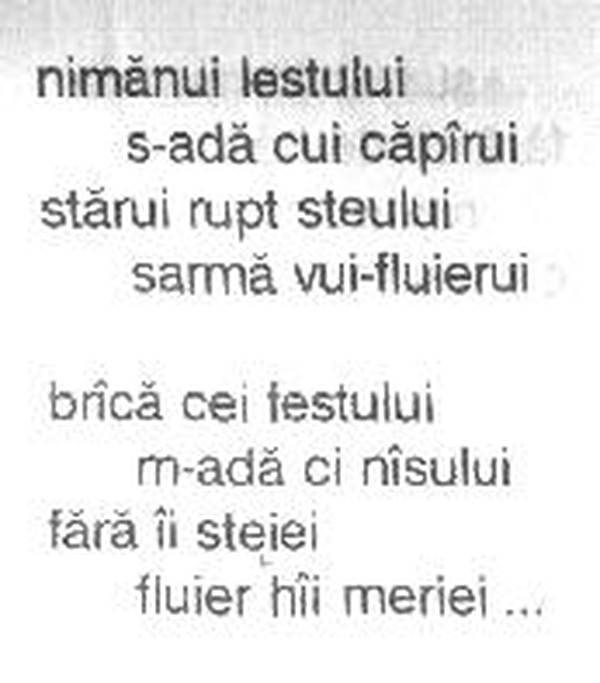
nimănui lestului
s-adă cui căpîrui
stărui rupt steului
sarmă vui-fluierui

brîca cei festului
m-adă ci nîsului
fără îi stejei
fluier hîi meriei …
A verse made of -ului and -ei rhymes. Nobody’s — let him bring it to anyone — insist on what’s torn off the staff — a salt-wager of the flute. Second stanza: graze, gather to the bridle — without your tip — flute of the goose-quill. The verse is a chant of belonging-to-nobody , addressed in part to a flute that belongs to no one in particular. A folk-cadence of refusing ownership of the small instrument. (Lower confidence on individual words; the chant-form holds the verse together.)
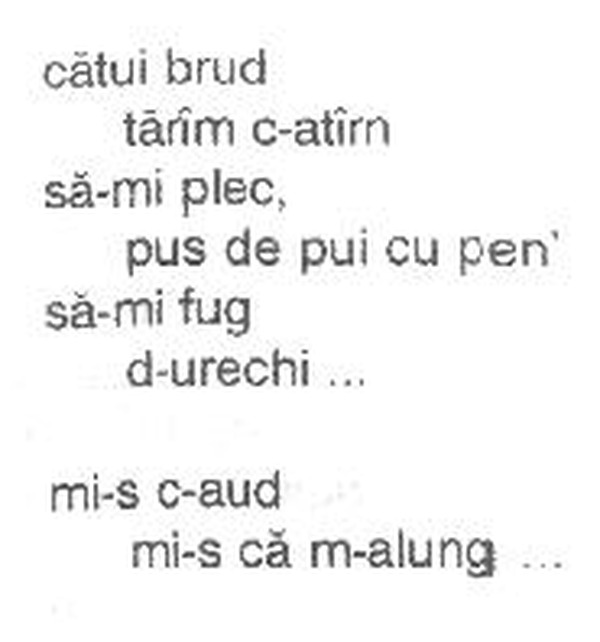
cătui brud
  tărîm c-atîrn
să-mi plec,
pus de pui cu pen'
să-mi fug
  d-urechi …

mi-s c-aud
mi-s că m-alung …
A verse of binding. Coupled rope, I’m a frame stretched out tight — to take my leave — with quill set on quill — to fly — ear over ear. Closes with two lines: seems I hear — seems I’m being chased. A short verse of getting ready to go, hurriedly, fearfully. The image of tied quills ( pen' de pui cu pen' ) reads as wings being made. The closing lines — seems I hear, seems I’m being chased — turn the leaving into flight from. A small flight-verse with a fearful end.
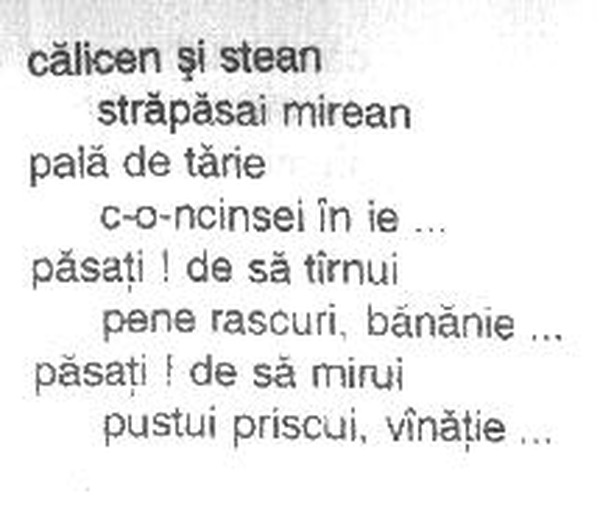
călicen și stean
  străpăsai mirean
pală de tărie
c-o-ncinsei în ie …
păsați ! de să tîrnui
pene rascuri, bănănie …
păsați ! de să mirui
  pustui priscui, vînătie …
A verse of cold and bird-imagery. Frost-bound and standstill, I cut through the high meadow; a slap of strength I bound into my linen. Second stanza: birds! to startle them — the loose feathers, the swirl — birds! to surprise them — the wasteland of perches, the chase. A verse of striding through cold to scare up birds, repeated in two parallel păsați ! exclamations. Rural, energetic, a single morning movement caught in seven lines.
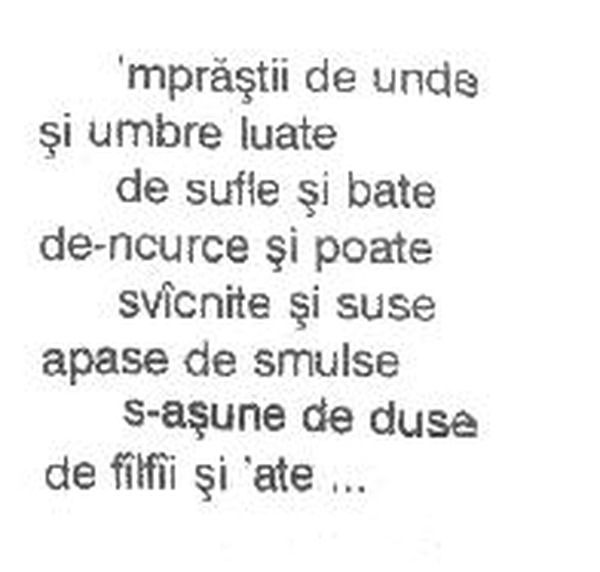
'mprăștii de unde
și umbre luate
de sufle și bate
de-ncurce și poate
svîcnite și suse
apase de smulse
  s-așune de duse
de filfii și 'ate …
A verse of shaking-loose. Scatter from where they came — the borrowed shadows — from the souls that beat — that tangle and yet might — brushed and lifted — pressed from what was crushed. Closes: let them sound, gone away, of cobwebs and ate. A verse of releasing what was held — shadows, beating souls, brushings, pressings — into the sound of cobweb and chaff. Read as a small kind of letting-go ritual. (Medium confidence.)
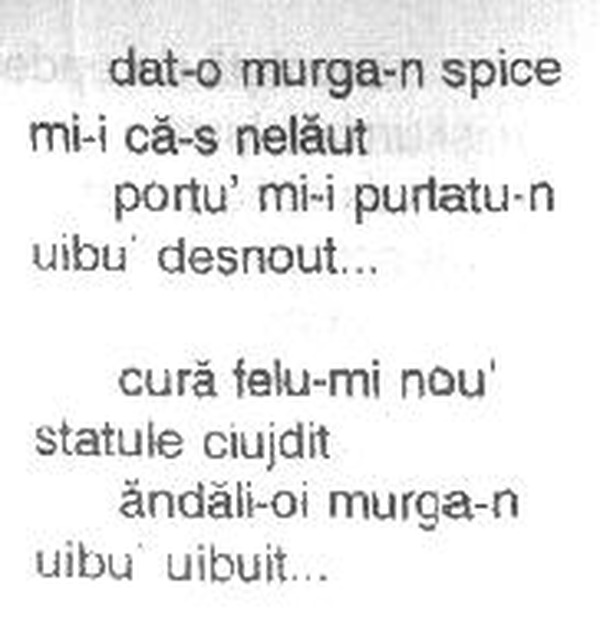
dat-o murga-n spice
mi-i că-s nelăut
  portu' mi-i purtatu-n
uibu' desnout …

cură felu-mi nou'
statule ciujdit
  ăndăli-oi murga-n
uibu' uibuit …
It gave itself, murga, into the ears of grain — mine that I’m unanointed — my own attire is the worn-cloth, unspun. Second stanza: my new way runs clear — my state purified — I’ll lay murga down again in the unspun garment. Two stanzas about murga — the dark mare, or the dusk — given over and then settled again. A verse of dress, of returning oneself to plain cloth. (Medium confidence; murga as image-cluster is the load-bearing word.)
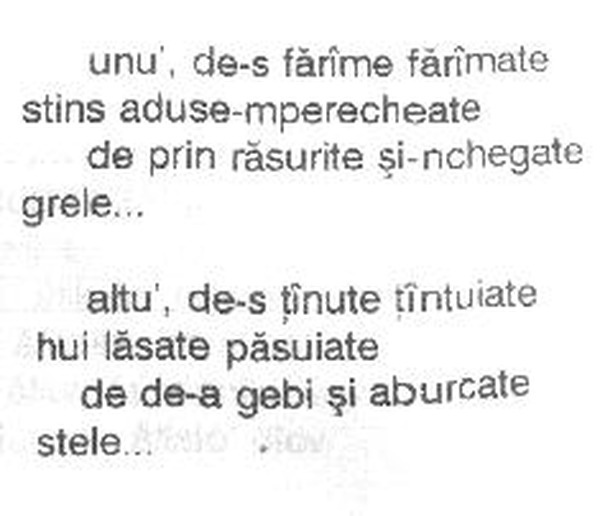
unu', de-s fărîme fărîmate
stins aduse-mperecheate
  de prin răsurite și-nchegate
grele…

altu', de-s ținute țîntuiate
hui lăsate păsuiate
de-a gebi și aburcate
stele …
A two-stanza verse with parallel scaffolding. One — with breaks broken up, with quenched gatherings, from places risen up and shut, heavy… The other — with held things held still, with hue laid and stretched, with the going-without and the rising of stars. A spare, formal verse of two kinds of broken-and-held. The first stanza is heaviness; the second is stretched lightness. Each names a way that pieces gather. (Medium confidence.)
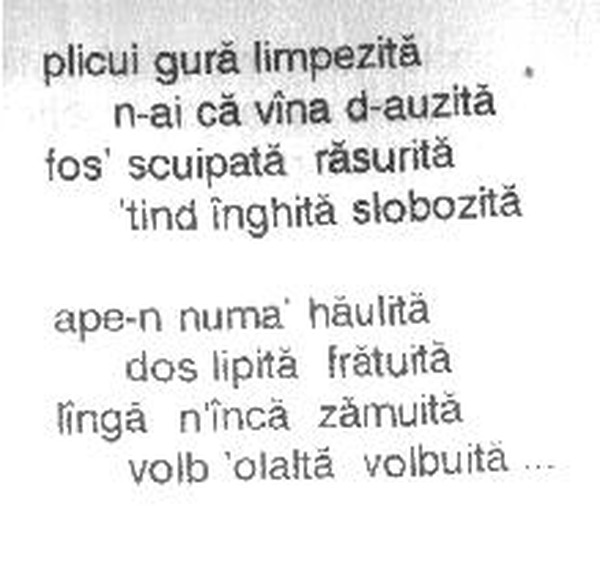
plicui gură limpezită
  n-ai că vîna d-auzită
fos' scuipată răsurită
'tînd înghiță slobozită

ape-n numa' hăulită
dos lipită frătuită
lîngă n'încă zămuită
volb 'olaltă volbuită …
A long verse of speech and water. The little mouth was cleared — you’ve no vein for what was heard — spat clear, risen, swallowing the freed. Second stanza: waters only, hollering — back-pressed, broken-bonded — near where it lay milled — a tangle wound on itself together-wound. The verse is densely sonorous — every line ends in -ită . A chant-poem of running waters and the cleared mouth that lets them through. (Medium-low confidence; the assonance is doing the work.)
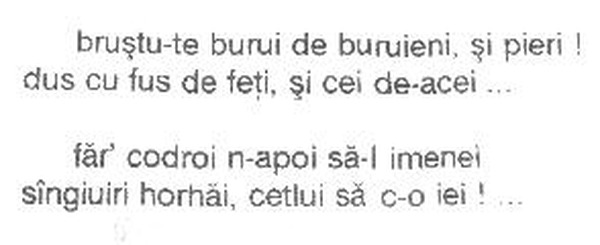
bruștu-te burui de buruieni, și pieri !
dus cu fus de feți, și cei de-acei …

făr' codroi n-apoi să-l imenei
sînguiri horhăi, cetlui să c-o iei ! …
A short curse-verse, addressed to a third party. Burst of weeds upon you, weed of weeds, and perish! Gone with sons’ distaffs, and the rest of them. Second stanza: without rags now, lead him by name — alone he’s wandering, may the cur take him! A folk-imprecation, almost playful in its venom — the kind of curse one might lay on a wayward neighbor. Plain in register, sharp in tone.
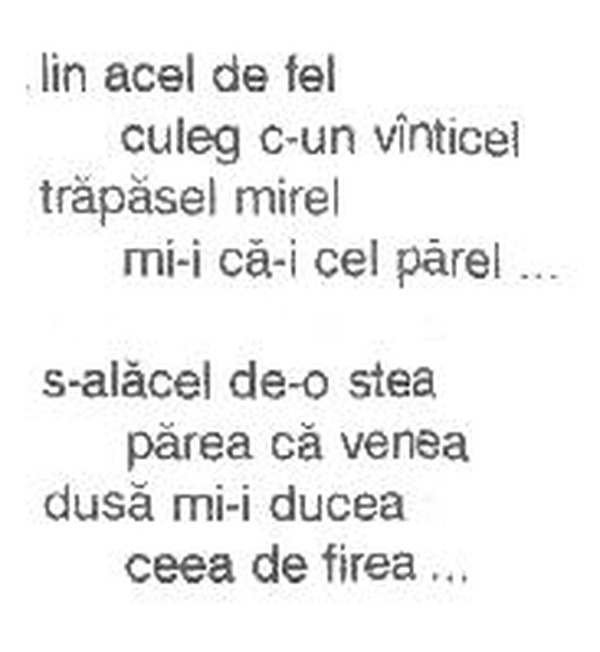
lin acel de fel
  culeg c-un vînticel
trăpășel mirel
  mi-i că-i cel părel …

s-alăcel de-o stea
  părea că venea
dușă mi-i ducea
ceea de firea …
Lin acel de fel — gentle that of fellow. I gather him with a small wind, a fluttering little colt, mine because he’s the slip-of-paper-one. Second stanza: I lay him down by a star — she seemed to be coming — mournful she took herself away — she of the very thread. A small grief-verse about a gentle figure (a foal? a child?) gathered up and laid down by a star, and a mournful woman taking herself away. (Medium confidence.)
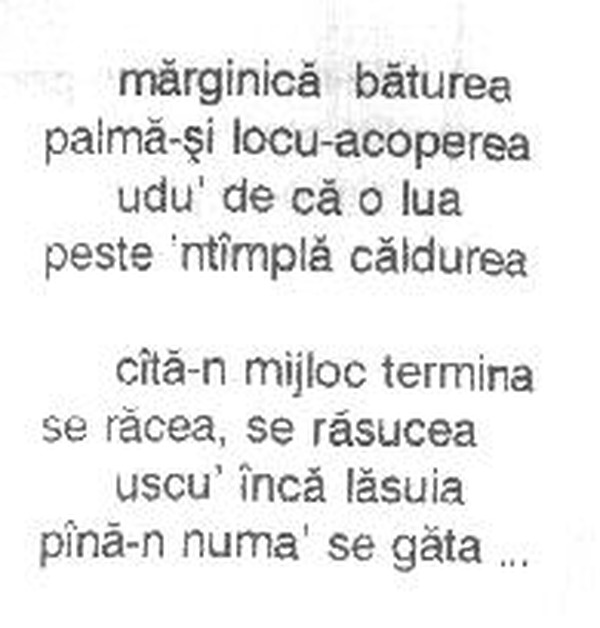
mărginică bătura
palmă-și locu-acoperea
udu' de că o lua
peste 'ntîmpla căldurea

cîtă-n mijloc termina
se răcea, se răsucea
uscu' încă lăsuia
pînă-n numa' se găta …
A verse of beating cloth or sweeping — small repetitive labor. The little edge-stick took the place of the palm — her water either took it or carried it — over the warmth happening. Second stanza: how the middle finished — she cooled, she turned herself — the dryness still lessened — until only she was done. A verse of a woman doing a household task that finishes itself in a sequence of cooling and turning. Domestic, particular, slightly tender. (Medium confidence.)
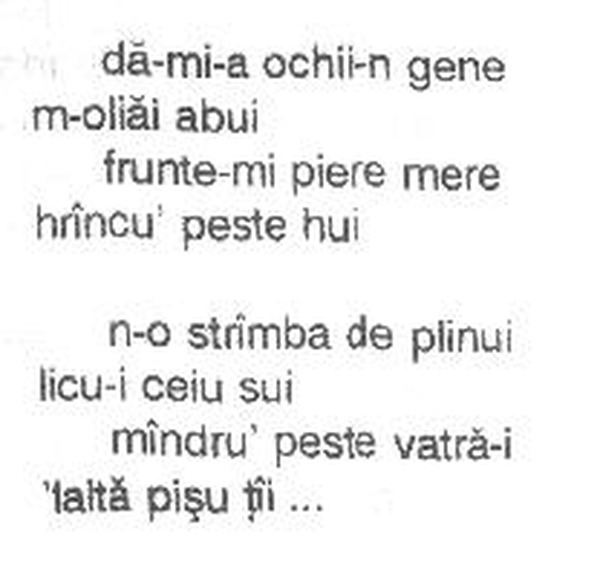
dă-mi-a ochii-n gene
m-oliăi abui
  frunte-mi piere mere
hrîncu peste hui

n-o strimba de plinui
licu-i ceiu sui
  mîndru' peste vatră-i
'laită pișu țîi …
A two-stanza verse of dressing. Give me eyes in lashes — I’ll be steamy from it — my forehead will lose its apples — the dock-leaf over my hill. Second stanza: I’ll not bend at the brim — my licou is white in coil — lordly across my hearth-stone — my finery you’ll hold. A verse spoken by someone dressing themselves up, naming the parts — eyes, forehead, brim, hearth-stone — with a country boast in the closing lines. (Medium-low confidence; the dressing-up gesture is the clearer move.)
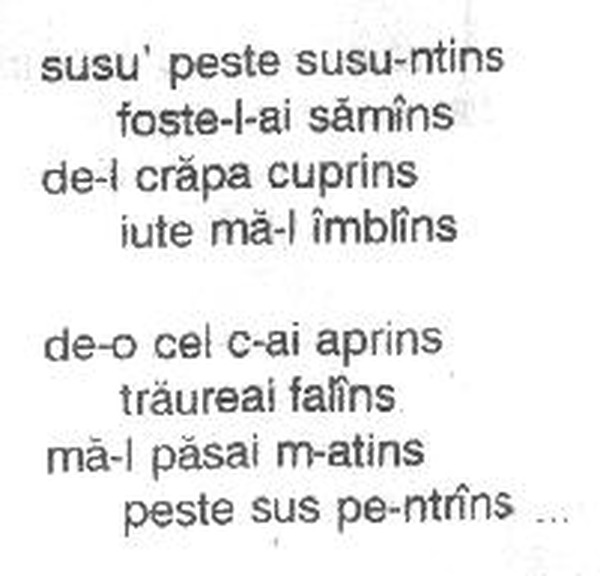
susu' peste susu-ntîns
foste-l-ai sărmîns
de-l crăpa cuprins
iute mă-l îmblîns

de-o cel c-ai aprins
trăureai falîns
mă-l păsai m-atîns
peste sus pe-ntrîns …
A verse of beyond-and-back. High over a high-stretched thing — you should have been like that — if its full breadth grasped you — quickly I’d soften it. Second stanza: from there if you took fire — only-walls falling — let me pass you, take you — up over what was pierced through. A verse of two paired commands — should you have been there, then I’d soften; should you take fire, then let me pass. The shape is condition-and-promise, twice. (Medium confidence.)
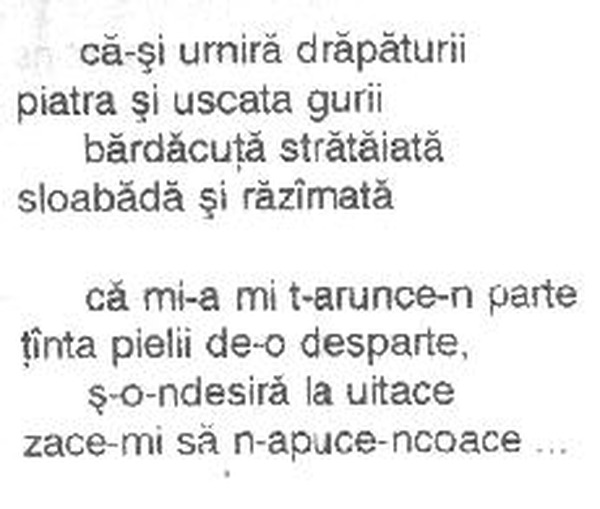
că-și urnirea drăpăturii
piatra și uscata gurii
bărdăcuța strătăiată
sloabădă și răzimată

că mi-a mi t-arunce-n parte
țînta pielii de-o desparte,
ș-o-ndesiră la uitace
zace-mi să n-apuce-ncoace …
A verse of bones and dryness. The patches’ spreading came on her — the stone and the dryness of her mouth — the little flask split, hollowed and propped against. Second stanza: that she pulled me aside — the speck of skin that parted her — and they pressed her at the unseeing — lay me to keep her from coming back. A grief-verse about a sick or dying woman — the dryness, the stone, the little flask. Specific bodily detail. (Medium confidence.)
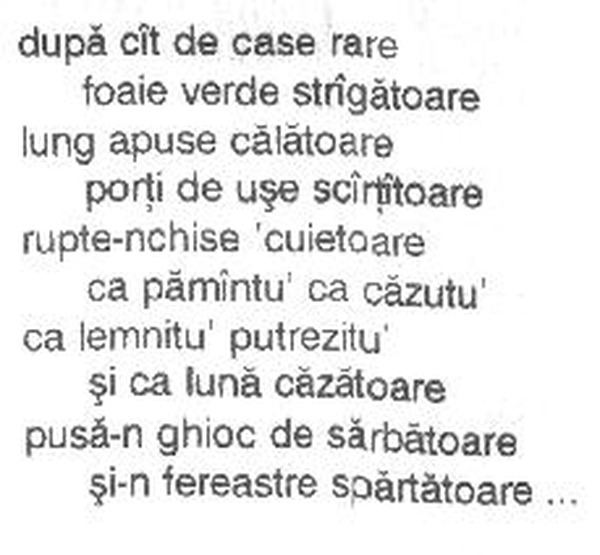
după cît de case rare
  foaie verde strigătoare
lung apuse călătoare
  porți de ușe scîrțîtoare
rupte-nchise 'cuietoare
    ca pămîntu' ca căzutu'
ca lemnitu' putrezitu'
  și ca lună deodată
  pusă-n ghioc de sărbătoare
și-n fereastre spărtătoare …
The longest verse in the book, a roll-call of -toare rhymes. After so many rare houses — green pages strident — long set wandering — doors with creaking hinges — broken-shut, latched — like earth, like fallen things — like wood, like rotted things — and like a holiday moon set in a pendant — and breaking out of the windows. A verse of abandoned houses on a long evening, named in a long, breathy list of feminine adjectives. The closing image — a holiday moon in a pendant breaking out of the windows — lifts the catalogue out of the abandoned and into a single celebratory image at the end.
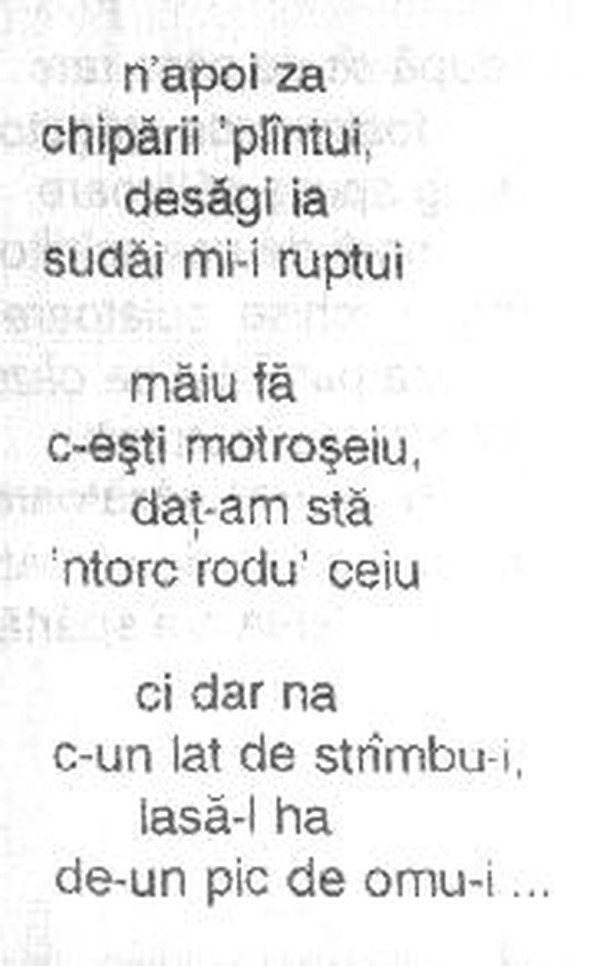
n-apoi za
chipării 'plîntui,
desăgi ia
sudăi mi-i ruptui

măiu fă
c-ești motroșeiu,
dat-am stă
'ntorc rodu' ceiu

ci dar na
c-un lat de strîmbu-i,
lasă-l ha
de-un pic de omu-i …
A verse of three short stanzas, all addressed to măiu directly. That afterward — full ladles — satchels taken — my sweats torn. Măiu, you do this — you’re a wadge of a fellow — I’ve been giving stand-room — I’ll return the harvest, măiu’s. But here, take — one width of crooked — leave it be — for a bit of man. A direct address to măiu — the month? the friend? the verse-naming particle? — that lands as conversation. The book’s title-word is finally spoken to. (Medium confidence; the address is clearer than the precise transactions.)
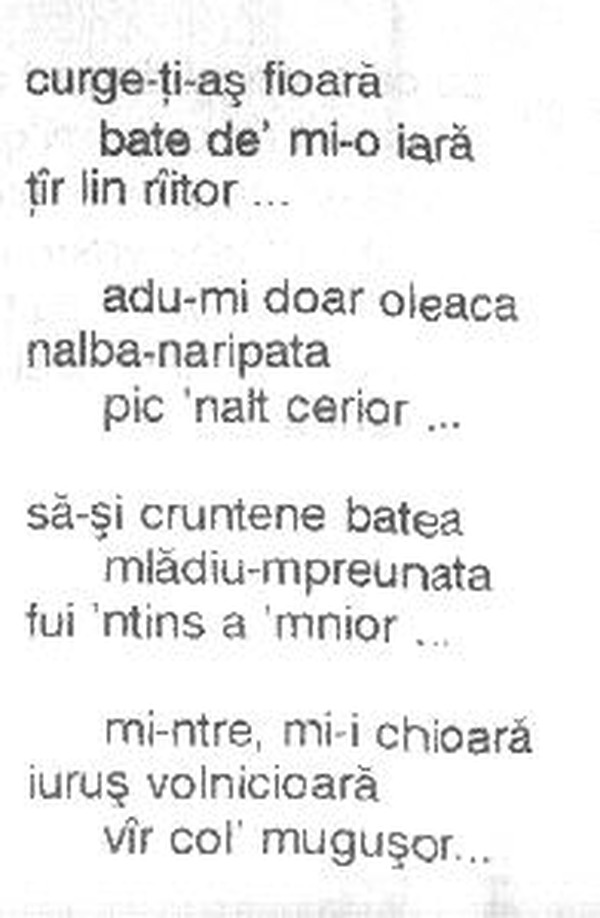
curge-ți-ai fioară
  bate de' mi-o iară
țîr lin riitor …

  adu-mi doar oleacă
nalba-naripata
pic 'nalt cerior …

să-și cruntene batea
mlădiu-mpreunata
fui 'ntins a 'mnior …

  mi-ntre, mi-i chioară
iuruș volnicioară
vîr col' mugușor …
A four-stanza verse of riverlike imagery and rhyme. Run, my little fountain — beat for me again — little trickle in the chinking thatch. Bring me only a little — the winged mallow — a tall droplet of sky. Let her cruel one beat — her cradle-rocked one — you, I rested, of a moaning. Me-between, mine the cripple-one — bursting from these, a willful one — the bend at the corner of the bud. A song-verse with strong song-cadence; the title’s măiu is heard in the rhyme. (Medium-low confidence on individual lines; the song-pattern carries the verse.)
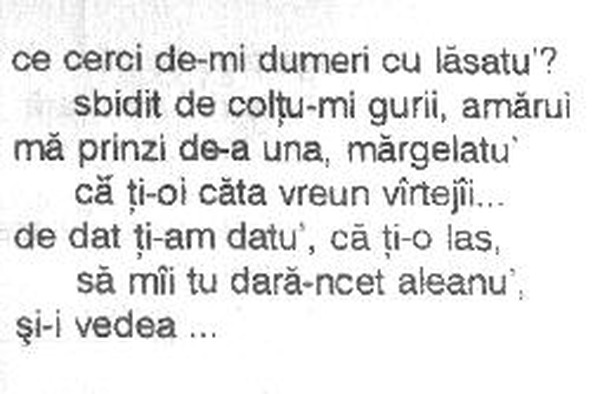
ce cerci de-mi dumeri cu lăsatu'?
  sbidit de colțu-mi gurii, amărui
mă prinzi de-a una, mărgelatu'
că ți-oi cîta vreun vîrteji…
de dat ți-am datu', că ți-o las,
  să mîi tu dară-ncet aleanu'
și-i vedea …
A verse of complaint and refusal. Why are you asking me to give up? The speaker has been ground down by the corner of his mouth, slightly bitter; if I’m grabbed unawares, my little glass-bead one, I’d still find you a swirl. What was given was given — I let go — let it be that you ease your grievance slowly — and you’ll see. A quietly defiant verse about being asked to surrender. The voice is intimate, tired, slightly resigned but unyielding.
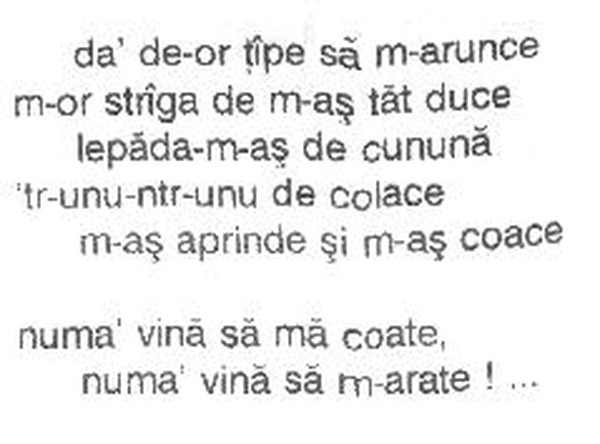
da' de-or țîpe să m-arunce
m-or strîga de m-aș tăt duce
lepăda-m-aș de cunună
'tr-unu-ntr-unu de colace
  m-aș aprinde și m-aș coace

numa' vină să mă coate,
numa' vină să m-arate ! …
A verse of being driven out. But if they shout to throw me out — if they cry to drive me away — I’ll cast off the crown — one inside one of these long round breads — I’ll catch fire and bake. Closes: Only let her come summon me — only let her come show me! A folk-bridal cadence flipped to defiance — the speaker imagines being driven out, casting off the crown into the colaci (festival breads), burning in among them — if only she would come and look. Brilliant, defiant, slightly bawdy.
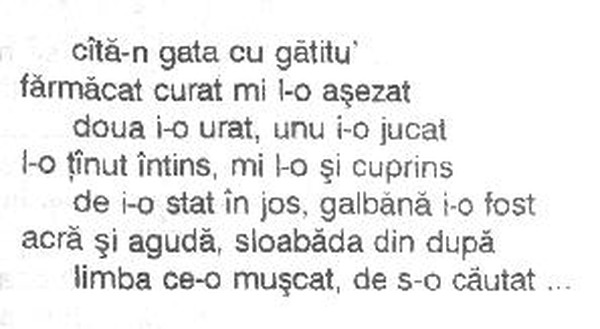
cîta-n gata cu gătitu'
fărmăcat curat mi l-o așezat
doua i-o urat, unu i-o jucat
l-o ținut întins, mi l-o și cuprins
de i-o stat în jos, galbănă i-o fost
acră și agudă, sloabăda din după
limba ce-o mușcat, de s-o cătăut …
A verse of a witch-treatment. The thing prepared and prepared again was charmed clean and laid out: two cursed it, one played at it, kept it stretched, even gathered it — from it sitting low, yellow came out of it — sour and bitter, slack from after — the tongue that bit it, that they hunted out. A single long compound sentence describing a folk-charm done to something or someone — almost a recipe or an incantation. The verse names every step. (Medium confidence; the folk-charm shape is clearer than each action.)
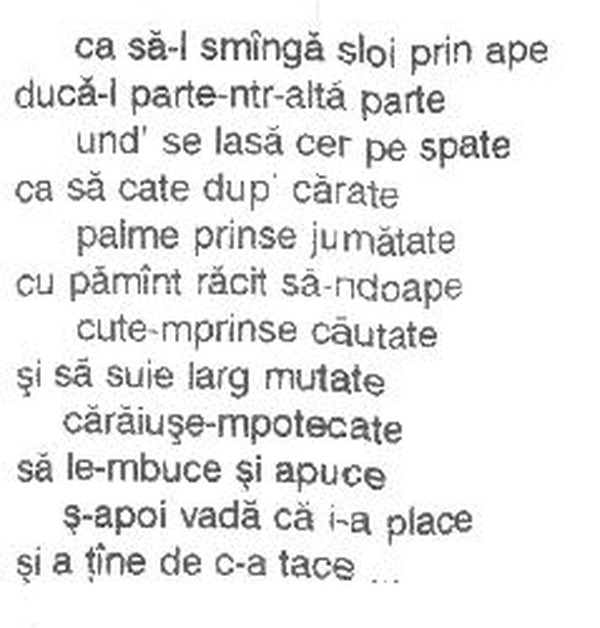
ca să-l smîngă sloi prin ape
ducă-l parte-ntr-altă parte
und' se lasă cer pe spate
ca să cate dup' cărate
palme prinse jumătate
cu pămînt răcit să-ndoape
cute-mprinse căutate
și să suie larg mutate
cărăiușe-mpotecate
să le-mbuce și apuce
ș-apoi vadă că i-a place
și a ține de c-a tace …
The book’s closing verse — long, accumulating, every line ending in -ate . That he might smooth ice-floes through the waters, take it part-by-part, where the sky lets itself onto its back — that he might hunt for hidden things, hands taken halfway, with cool earth to bury, sharp-cut things looked-for — and that he might rise widely shifted, on knotted little paths, that he might come up against them and take them, and then see that it pleased him, and hold his peace. A verse-long single arc of an unnamed he going to the waters and the earth, doing labor of grasping and burying, finally rising and choosing silence. The closing of măiu lands on labor — and held to be silent — the patient, quiet ending after thirty-seven verses of weather and people. Contact Instagram © 2026 C Fodoreanu · San Diego · New York